
Anaconda Introduces Groundbreaking Unified AI Platform for Open Source, Transforming Enterprise AI Development

Anaconda Inc. Unveils Groundbreaking Anaconda AI Platform: Revolutionizing Open Source AI Development

In a momentous development for the open-source AI community, Anaconda Inc, a longstanding leader in Python-based data science, has launched the Anaconda AI Platform. This innovative, all-in-one AI development platform is specifically designed for open-source environments. It streamlines and secures the entire AI lifecycle, empowering enterprises to transition from experimentation to production quicker, safer, and more efficiently than ever.

The launch symbolizes not just a new product, but a strategic transformation for the company—shifting from being the go-to package manager for Python to becoming the backbone for enterprise AI solutions focused on open-source innovation.

Bridging the Gap Between Innovation and Enterprise-Grade AI

The surge of open-source tools has been pivotal in the AI revolution. Frameworks like TensorFlow, PyTorch, scikit-learn, and Hugging Face Transformers have made experimentation more accessible. Nevertheless, organizations encounter specific hurdles when deploying these tools at scale, including security vulnerabilities, dependency conflicts, compliance risks, and governance challenges that often hinder enterprise adoption—stalling innovation right when it’s crucial.

Anaconda’s new platform is expressly designed to bridge this gap.

“Until now, there hasn’t been a unified destination for AI development in open source, which serves as the foundation for inclusive and innovative AI,” stated Peter Wang, Co-founder and Chief AI & Innovation Officer of Anaconda. “We offer not just streamlined workflows, enhanced security, and significant time savings but also empower enterprises to build AI on their terms—without compromise.”

The First Unified AI Platform for Open Source: Key Features

The Anaconda AI Platform centralizes everything enterprises need to create and operationalize AI solutions based on open-source software. Unlike other platforms that focus solely on model hosting or experimentation, Anaconda’s platform encompasses the entire AI lifecycle—from securing and sourcing packages to deploying production-ready models in any environment.

Core Features of the Anaconda AI Platform Include:

  • Trusted Open-Source Package Distribution:
    Gain access to over 8,000 pre-vetted, secure packages fully compatible with Anaconda Distribution. Each package is continuously tested for vulnerabilities, allowing enterprises to adopt open-source tools with confidence.
  • Secure AI & Governance:
    Features like Single Sign-On (SSO), role-based access control, and audit logging ensure traceability, user accountability, and compliance with key regulations such as GDPR, HIPAA, and SOC 2.
  • AI-Ready Workspaces & Environments:
    Pre-configured “Quick Start” environments for finance, machine learning, and Python analytics expedite value realization and lessen the need for complex setups.
  • Unified CLI with AI Assistant:
    A command-line interface, bolstered by an AI assistant, helps developers automatically resolve errors, reducing context switching and debugging time.
  • MLOps-Ready Integration:
    Integrated tools for monitoring, error tracking, and package auditing streamline MLOps (Machine Learning Operations), bridging data science and production engineering.

Understanding MLOps: Its Significance in AI Development

MLOps is to AI what DevOps is to software development—a set of practices and tools that ensure machine learning models are not only developed but also responsibly deployed, monitored, updated, and scaled. Anaconda’s AI Platform is closely aligned with MLOps principles, enabling teams to standardize workflows and optimize model performance in real-time.

By centralizing governance, automation, and collaboration, the platform streamlines a typically fragmented and error-prone process. This unified approach can significantly benefit organizations looking to industrialize AI capabilities across their teams.

Why Now? Capitalizing on Open-Source AI Amidst Hidden Costs

Open-source has become the bedrock of contemporary AI. A recent study cited by Anaconda revealed that 50% of data scientists use open-source tools daily, while 66% of IT administrators recognize open-source software’s crucial role in their enterprise tech stacks. However, this freedom comes at a cost—particularly related to security and compliance.

Every package installed from public repositories like PyPI or GitHub poses potential security risks. Tracking such vulnerabilities manually is challenging, especially as organizations rely on numerous packages with complicated dependencies.

The Anaconda AI Platform abstracts this complexity, providing teams with real-time insights into package vulnerabilities, usage patterns, and compliance requirements—all while utilizing the tools they already trust.

Enterprise Impact: Unlocking ROI and Mitigating Risk

To assess the platform’s business value, Anaconda commissioned a Total Economic Impact™ (TEI) study from Forrester Consulting. The results are impressive:

  • 119% ROI over three years.
  • 80% improvement in operational efficiency (valued at $840,000).
  • 60% reduction in security breach risks related to package vulnerabilities.
  • 80% decrease in time spent on package security management.

These findings indicate that the Anaconda AI Platform is more than just a development tool—it serves as a strategic enterprise asset that minimizes overhead, boosts productivity, and accelerates AI development timelines.

Anaconda: A Legacy of Open Source, Empowering the AI Era

Founded in 2012 by Peter Wang and Travis Oliphant, Anaconda established itself in the AI and data science landscape with the mission to elevate Python—then an emerging language—into mainstream enterprise data analytics. Today, Python stands as the most widely adopted language in AI and machine learning, with Anaconda at the forefront of this evolution.

From a small team of open-source contributors, Anaconda has evolved into a global entity with over 300 employees and more than 40 million users worldwide. The company actively maintains and nurtures many open-source tools integral to data science, including conda, pandas, and NumPy.

Anaconda represents more than a company; it embodies a movement. Its tools are foundational to key innovations at major firms like Microsoft, Oracle, and IBM, and power systems like Python in Excel and Snowflake’s Snowpark for Python.

“We are—and will always be—committed to fostering open-source innovation,” Wang states. “Our mission is to make open source enterprise-ready, thus eliminating roadblocks related to complexity, risk, or compliance.”

Future-Proofing AI at Scale with Anaconda

The Anaconda AI Platform is now available for deployment in public, private, sovereign cloud, and on-premise environments, and is also listed on AWS Marketplace for seamless procurement and integration.

In an era where speed, trust, and scalability are critical, Anaconda has redefined what’s achievable for open-source AI—not only for individual developers but also for the enterprises that depend on their innovations.

Here are five FAQs based on the topic of Anaconda’s launch of its unified AI platform for open source:

FAQ 1: What is Anaconda’s new unified AI platform?

Answer: Anaconda’s unified AI platform is a comprehensive solution designed to streamline and enhance enterprise-grade AI development using open-source tools. It integrates various functionalities, allowing teams to build, deploy, and manage AI models more efficiently, ensuring collaboration and scalability.


FAQ 2: How does this platform redefine enterprise-grade AI development?

Answer: The platform redefines AI development by providing a cohesive environment that combines data science, machine learning, and AI operations. It facilitates seamless integration of open-source libraries, promotes collaboration among teams, and ensures compliance with enterprise security standards, speeding up the development process from experimentation to production.


FAQ 3: What are the key features of Anaconda’s AI platform?

Answer: Key features of Anaconda’s AI platform include:

  • A unified interface for model development and deployment.
  • Integration with popular open-source libraries and frameworks.
  • Enhanced collaboration tools for data scientists and machine learning engineers.
  • Robust security features ensuring compliance with enterprise policies.
  • Tools for monitoring and optimizing AI models in real time.

FAQ 4: Who can benefit from using this platform?

Answer: The platform is designed for data scientists, machine learning engineers, IT professionals, and enterprises looking to leverage open-source technology for AI development. Organizations of all sizes can benefit, particularly those seeking to enhance collaboration and productivity while maintaining rigorous security standards.


FAQ 5: How does Anaconda support open-source initiatives with this platform?

Answer: Anaconda actively supports open-source initiatives by embedding popular open-source libraries into its AI platform and encouraging community contributions. The platform not only utilizes these tools but also provides an environment that fosters innovation and collaboration among open-source developers, thus enhancing the overall AI development ecosystem.

Source link

Understanding Why Language Models Struggle with Conversational Context

New Research Reveals Limitations of Large Language Models in Multi-Turn Conversations

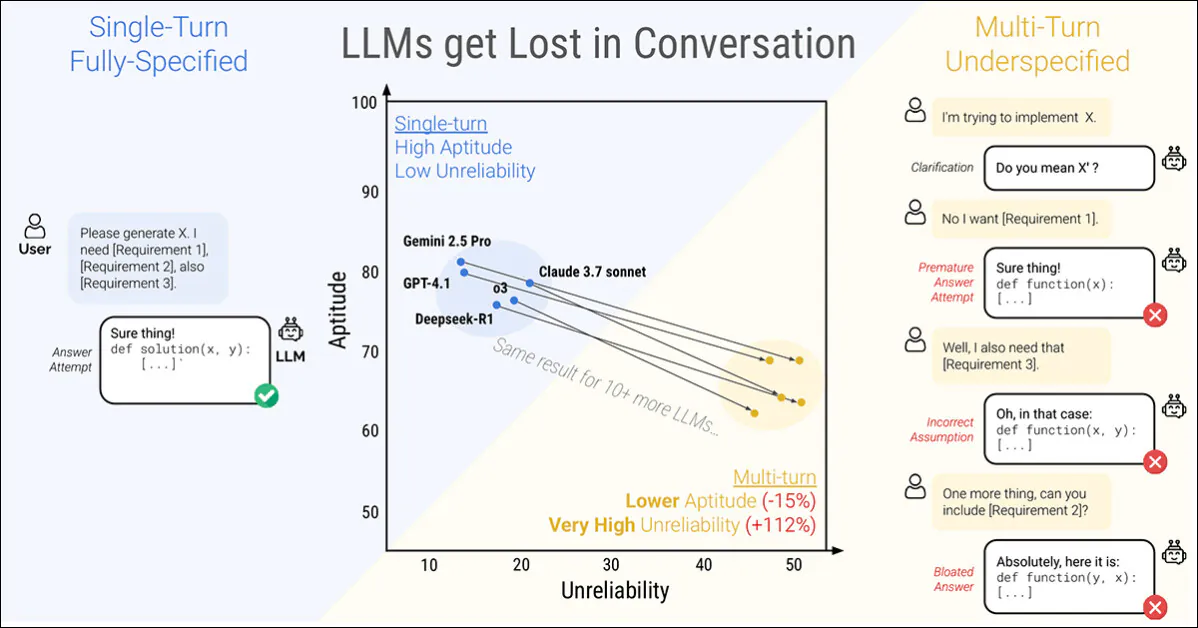
A recent study from Microsoft Research and Salesforce highlights a critical limitation in even the most advanced Large Language Models (LLMs): their performance significantly deteriorates when instructions are given in stages rather than all at once. The research found an average performance drop of 39% across six tasks when prompts are split over multiple turns:

A single turn conversation (left) obtains the best results. A multi-turn conversation (right) finds even the highest-ranked and most performant LLMs losing the effective impetus in a conversation. Source: https://arxiv.org/pdf/2505.06120

A single-turn conversation (left) yields optimal results while multi-turn interactions (right) lead to diminished effectiveness, even in top models. Source: arXiv

The study reveals that the reliability of responses drastically declines with stage-based instructions. Noteworthy models like ChatGPT-4.1 and Gemini 2.5 Pro exhibit fluctuations between near-perfect answers and significant failures depending on the phrasing of tasks, with output consistency dropping by over 50%.

Understanding the Problem: The Sharding Method

The paper presents a novel approach termed sharding, which divides comprehensive prompts into smaller fragments, presenting them one at a time throughout the conversation.

This methodology can be likened to placing a complete order at a restaurant versus engaging in a collaborative dialogue with the waiter:

Illustration of conversational dynamics in a restaurant setting.

Two extremes of conversation depicted through a restaurant scenario (illustrative purposes only).

Key Findings and Recommendations

The research indicates that LLMs tend to generate excessively long responses, clinging to misconceived insights even after their inaccuracies are evident. This behavior can lead the system to completely lose track of the conversation.

Interestingly, it has been noted, as many users have experienced, that starting a new conversation often proves to be a more effective strategy than continuing an ongoing one.

‘If a conversation with an LLM did not yield expected outcomes, collecting the same information in a new conversation can lead to vastly improved results.’

Agent Frameworks: A Double-Edged Sword

While systems like Autogen or LangChain may enhance outcomes by acting as intermediary layers between users and LLMs, the authors argue that such abstractions should not be necessary. They propose:

‘Multi-turn capabilities could be integrated directly into LLMs instead of relegated to external frameworks.’

Sharded Conversations: Experimental Setup

The study introduces the idea of breaking traditional single-turn instructions into smaller, context-driven shards. This new construct simulates dynamic, exploratory engagement patterns similar to those found in systems like ChatGPT or Google Gemini.

The simulation progresses through three entities: the assistant, the evaluated model; the user, who reveals shards; and the system, which monitors and rates the interaction. This configuration mimics real-world dialogue by allowing flexibility in how the conversation unfolds.

Insightful Simulation Scenarios

The researchers employed five distinct simulations to scrutinize model behavior under various conditions:

  • Full: The model receives the entire instruction in a single turn.
  • Sharded: The instruction is divided and provided across multiple turns.
  • Concat: Shards are consolidated into a list, removing their conversational structure.
  • Recap: All previous shards are reiterated at the end for context before a final answer.
  • Snowball: Every turn restates all prior shards for increased context visibility.

Evaluation: Tasks and Metrics

Six generation tasks were employed, including code generation and Text-to-SQL prompts from established datasets. Performance was gauged using three metrics: average performance, aptitude, and unreliability.

Contenders and Results

Fifteen models were evaluated, revealing that all showed performance degradation in simulated multi-turn settings, coining this phenomenon as Lost in Conversation. The study emphasizes that higher performance models struggled similarly, dispelling the assumption that superior models would maintain better reliability.

Conclusions and Implications

The findings underscore that exceptional single-turn performance does not equate to multi-turn reliability. This raises concerns about the real-world readiness of LLMs, urging caution against dependency on simplified benchmarks that overlook the complexities of fragmented interactions.

The authors conclude with a call to treat multi-turn ability as a fundamental skill of LLMs—one that should be prioritized instead of externalized into frameworks:

‘The degradation observed in experiments is a probable underestimation of LLM unreliability in practical applications.’

Here are five FAQs based on the topic "Why Language Models Get ‘Lost’ in Conversation":

FAQ 1: What does it mean for a language model to get ‘lost’ in conversation?

Answer: When a language model gets ‘lost’ in conversation, it fails to maintain context or coherence, leading to responses that are irrelevant or off-topic. This often occurs when the dialogue is lengthy or when it involves complex topics.


FAQ 2: What are common reasons for language models losing track in conversations?

Answer: Common reasons include:

  • Contextual Limitations: Models may not remember prior parts of the dialogue.
  • Ambiguity: Vague or unclear questions can lead to misinterpretation.
  • Complexity: Multistep reasoning or nuanced topics can confuse models.

FAQ 3: How can users help language models stay on track during conversations?

Answer: Users can:

  • Be Clear and Specific: Provide clear questions or context to guide the model.
  • Reinforce Context: Regularly remind the model of previous points in the conversation.
  • Limit Complexity: Break down complex subjects into simpler, digestible questions.

FAQ 4: Are there improvements being made to help language models maintain context better?

Answer: Yes, ongoing research focuses on enhancing context tracking in language models. Techniques include improved memory mechanisms, larger contexts for processing dialogue, and better algorithms for understanding user intent.


FAQ 5: What should I do if a language model responds inappropriately or seems confused?

Answer: If a language model seems confused, you can:

  • Rephrase Your Question: Try stating your question differently.
  • Provide Additional Context: Offering more information may help clarify your intent.
  • Redirect the Conversation: Shift to a new topic if the model is persistently off-track.

Source link

Dream 7B: The Impact of Diffusion-Based Reasoning Models on AI Evolution

<div id="mvp-content-main">
  <h2><strong>Revolutionizing AI: An Introduction to Dream 7B</strong></h2>
  <p><a target="_blank" href="https://www.unite.ai/machine-learning-vs-artificial-intelligence-key-differences/">Artificial Intelligence (AI)</a> has advanced significantly, evolving from basic text and image generation to sophisticated systems capable of reasoning, planning, and decision-making. With AI's evolution, there's a rising need for models that tackle more complex tasks. Traditional models, like <a target="_blank" href="https://openai.com/index/gpt-4/">GPT-4</a> and <a target="_blank" href="https://www.llama.com/">LLaMA</a>, have marked important milestones but often struggle with reasoning and long-term planning challenges. Enter <a target="_blank" href="https://hkunlp.github.io/blog/2025/dream/">Dream 7B</a>, which introduces a diffusion-based reasoning model designed to enhance quality, speed, and flexibility in AI-generated content.</p>

  <h3><strong>Understanding Diffusion-Based Reasoning Models</strong></h3>
  <p>Diffusion-based reasoning models, such as Dream 7B, signal a major shift from conventional AI language generation techniques. For years, autoregressive models have dominated the landscape, constructing text one token at a time by predicting the next word based solely on preceding ones. While effective, this method has limitations, particularly in tasks demanding long-term reasoning and complex planning.</p>
  <p>In contrast, <a target="_blank" href="https://www.unite.ai/diffusion-models-in-ai-everything-you-need-to-know/">diffusion models</a> reshape the approach to language generation. Instead of building a sequence word by word, they commence with a noisy sequence and systematically refine it through multiple steps. Starting from nearly random content, the model iteratively denoises, adjusting values until the output is both meaningful and coherent. This method enables the simultaneous refinement of the entire sequence rather than a serialized process.</p>
  <p>By processing sequences in parallel, Dream 7B captures context from both the beginning and end, resulting in outputs that are more accurate and contextually aware. This sets diffusion models apart from autoregressive ones, bound to a left-to-right generation paradigm.</p>
  <p>The benefit of this technique lies in its improved coherence, especially over longer sequences. Traditional models can lose track of earlier context when generating text step-by-step, compromising consistency. However, the parallel refinement of diffusion models allows for stronger coherence and context retention, making them ideal for tackling complex and abstract tasks.</p>
  <p>Moreover, diffusion-based models excel at reasoning and planning. Their structure allows them to handle tasks requiring multi-step reasoning and problem-solving within various constraints. Consequently, Dream 7B shines in advanced reasoning challenges where autoregressive models may falter.</p>

  <h3><strong>Diving into Dream 7B’s Architecture</strong></h3>
  <p>Dream 7B boasts a <a target="_blank" href="https://apidog.com/blog/dream-7b/">7-billion-parameter architecture</a> designed for high performance and precise reasoning. While large, its diffusion-based framework enhances efficiency, enabling dynamic and parallelized text processing.</p>
  <p>The architecture incorporates several key features, including bidirectional context modeling, parallel sequence refinement, and context-adaptive token-level noise rescheduling. These elements synergize to empower the model's capabilities in comprehension, generation, and text refinement, leading to superior performance in complex reasoning tasks.</p>

  <h3><strong>Bidirectional Context Modeling</strong></h3>
  <p>Bidirectional context modeling marks a pivotal departure from traditional autoregressive techniques, where models only focus on previous words to predict the next. Dream 7B, however, leverages a bidirectional strategy, enabling it to assess context from both past and future, enhancing its grasp of relationships between words and phrases. This approach yields outputs that are richer in context and coherence.</p>

  <h3><strong>Parallel Sequence Refinement</strong></h3>
  <p>Beyond bidirectionality, Dream 7B employs parallel sequence refinement. Whereas traditional models generate tokens one at a time, this model refines the complete sequence in tandem. This strategy maximizes context utilization from all sequence parts, allowing for accurate and coherent outputs, especially when deep reasoning is essential.</p>

  <h3><strong>Innovations in Autoregressive Weight Initialization and Training</strong></h3>
  <p>Dream 7B employs autoregressive weight initialization, leveraging pre-trained weights from models like <a target="_blank" href="https://huggingface.co/Qwen/Qwen2.5-7B">Qwen2.5 7B</a> to establish a robust foundation for language processing. This technique accelerates the model's adaptation to the diffusion framework. Furthermore, its context-adaptive token-level noise rescheduling refines the learning process by tailoring noise levels according to token context, thereby improving accuracy and relevance.</p>

  <h3><strong>How Dream 7B Outperforms Traditional Models</strong></h3>
  <p>Dream 7B distinguishes itself from conventional autoregressive models by offering notable enhancements in coherence, reasoning, and text generation flexibility, enabling superior performance in challenging tasks.</p>

  <h3><strong>Enhanced Coherence and Reasoning</strong></h3>
  <p>A major differentiation of Dream 7B is its capacity to uphold coherence over lengthy sequences. Traditional autoregressive models often lose track of earlier context, resulting in inconsistencies. The parallel processing approach of Dream 7B, however, fosters a consistent understanding throughout the text, yielding coherent and contextually rich outputs, particularly in complex tasks.</p>

  <h3><strong>Effective Planning and Multi-Step Reasoning</strong></h3>
  <p>Dream 7B also excels in scenarios requiring planning and multi-step reasoning. Traditional models, generating text step by step, struggle to maintain the necessary context for problems with multiple constraints. In contrast, Dream 7B’s simultaneous refinement considers both historical and future contexts, making it adept at handling tasks with various objectives, such as mathematical reasoning and logical puzzles. This results in more accurate outputs compared to models like LLaMA3 8B and Qwen2.5 7B.</p>

  <h3><strong>Flexible Text Generation</strong></h3>
  <p>Dream 7B offers unparalleled flexibility in text generation, unlike traditional autoregressive models that follow a rigid sequence. Users can adjust the number of diffusion steps, balancing speed and output quality. With fewer steps, users achieve rapid but less refined results; with more steps, they acquire higher-quality outputs at the expense of computational resources. This level of flexibility empowers users to tailor the model's performance to their specific needs, whether for quicker results or more thorough content.</p>

  <h2><strong>Potential Applications Across Industries</strong></h2>

  <h3><strong>Advanced Text Completion and Infilling</strong></h3>
  <p>Dream 7B’s capability to generate text in any order unlocks numerous possibilities, including dynamic content creation. It is adept at completing paragraphs or sentences based on partial inputs, making it perfect for drafting articles, blogs, and creative writing. Additionally, its prowess in document editing enhances infilling of missing sections in both technical and creative texts while preserving coherence.</p>

  <h3><strong>Controlled Text Generation</strong></h3>
  <p>With its flexible text generation ability, Dream 7B also excels in SEO-optimized content creation, generating structured texts that align with strategic keywords to elevate search engine rankings. Additionally, it adapts outputs to meet specific styles, tones, or formats, making it invaluable for professional reports, marketing materials, or creative projects.</p>

  <h3><strong>Quality-Speed Adjustability</strong></h3>
  <p>Dream 7B's diffusion-based architecture offers a unique blend of rapid content delivery and detailed text generation. For fast-paced initiatives like marketing campaigns or social media updates, it can swiftly produce outputs, whereas its capacity for quality and speed adjustments facilitates polished content suitable for sectors like legal documentation or academic research.</p>

  <h2><strong>The Bottom Line</strong></h2>
  <p>In summary, Dream 7B represents a significant leap in AI capabilities, enhancing efficiency and flexibility for intricate tasks that traditional models find challenging. By leveraging a diffusion-based reasoning model rather than conventional autoregressive approaches, Dream 7B elevates coherence, reasoning, and text generation versatility. This empowers it to excel across diverse applications, from content creation to problem-solving and planning, maintaining consistency and adeptness in tackling complex challenges.</p>
</div>

This rewritten article maintains the essence of the original content while improving clarity and flow. The headlines are structured for SEO, engaging, and informative, following HTML formatting best practices.

Here are five FAQs regarding "Dream 7B: How Diffusion-Based Reasoning Models Are Reshaping AI":

1. What are diffusion-based reasoning models?

Answer: Diffusion-based reasoning models are advanced AI frameworks that leverage diffusion processes to enhance reasoning and decision-making capabilities. These models utilize probabilistic approaches to propagate information through networks, allowing them to understand complex patterns and relationships in data more effectively.

2. How do diffusion-based reasoning models differ from traditional AI models?

Answer: Unlike traditional AI models that often rely on deterministic algorithms, diffusion-based models incorporate randomness and probability. This allows them to better simulate complex systems and handle uncertainty, leading to more robust reasoning and improved performance in tasks like image recognition and natural language processing.

3. What advantages do diffusion-based models offer in AI applications?

Answer: Diffusion-based models offer several advantages, including enhanced accuracy in predictions, improved adaptability to new data, and robustness against adversarial attacks. Their ability to model uncertainty makes them particularly effective in dynamic environments where traditional models may struggle.

4. In what industries are these models being utilized?

Answer: Diffusion-based reasoning models are being applied across various industries, including finance for risk assessment, healthcare for predictive analytics, autonomous vehicles for navigation systems, and entertainment for personalized recommendations. Their versatility makes them suitable for any domain requiring complex decision-making.

5. What is the future outlook for diffusion-based reasoning models in AI?

Answer: The future of diffusion-based reasoning models looks promising, with ongoing research focused on improving their efficiency and scalability. As AI continues to evolve, these models are expected to play a pivotal role in advancing machine learning capabilities, driving innovations in automation, data analysis, and beyond.

Source link

DeepSeek-GRM: Transforming Scalable and Cost-Effective AI Solutions for Businesses

Transforming AI Accessibility with DeepSeek-GRM

Many businesses face hurdles in embracing Artificial Intelligence (AI) due to high costs and complex technologies that often keep advanced models out of reach for smaller enterprises. DeepSeek-GRM tackles these challenges head-on, enhancing AI efficiency and accessibility to bridge the gap in AI adoption.

How DeepSeek-GRM Works: A New Era in AI

This groundbreaking model utilizes Generative Reward Modeling (GRM) to steer AI outputs towards responses that align closely with human expectations, ensuring interactions are both accurate and meaningful. Furthermore, Self-Principled Critique Tuning (SPCT) enhances AI reasoning, allowing the model to assess and refine its outputs in real time, leading to trustworthy results.

Introducing DeepSeek-GRM: The Future of AI Frameworks

DeepSeek-GRM, developed by DeepSeek AI, is an advanced framework aimed at significantly boosting the reasoning skills of large language models. It integrates two pivotal techniques: GRM and SPCT, effectively aligning AI with human preferences for improved decision-making.

Generative Reward Modeling: Redefining AI Evaluation

Unlike conventional methods that rely on simplistic scoring, GRM produces textual critiques and assigns descriptive numerical values to enhance response evaluation. This structured method ensures that feedback is relevant and tailored to specific tasks, unpacking qualities like Code Correctness and Documentation Quality.

SPCT: Training AI to Self-Assess

SPCT builds on GRM by training the model in two phases. The initial phase, Rejective Fine-Tuning (RFT), focuses on crafting precise principles and critiques while filtering out subpar examples. The second phase incorporates Rule-Based Online Reinforcement Learning (RL), reinforcing the model’s discernment between correct and incorrect responses while maintaining output quality.

Inference-Time Scaling Mechanisms: Efficiency Redefined

DeepSeek-GRM employs Inference-Time Scaling Mechanisms to maximize efficiency by scaling computing resources during inference instead of training. It runs multiple GRM evaluations in parallel, allowing for a robust assessment of different perspectives, ultimately leading to more accurate outcomes.

Mixture of Experts: Streamlining Computational Load

By utilizing a Mixture of Experts (MoE) approach, DeepSeek-GRM effectively activates tailored subnetworks for specific tasks, optimizing computational resources. A casting network directs which expert handles each task, ensuring scalability and efficiency without additional computing power.

Revolutionizing AI Development: The DeepSeek-GRM Impact

DeepSeek-GRM addresses the traditional trade-off between performance and computational efficiency, validating high-quality outputs without excessive infrastructure costs. Businesses can now harness advanced AI technologies without the typically high financial barriers.

Potential Applications of DeepSeek-GRM

DeepSeek-GRM is versatile, with applications across various industries. Below are a few areas where it can have a marked impact:

Streamlining Automation in Enterprises

DeepSeek-GRM offers solutions for automating intricate tasks like data analysis and customer support, making real-time processes more efficient and cost-effective. For instance, its capabilities can enable logistics companies to optimize delivery routes, significantly reducing delays.

Customer Service Transformation with AI Assistants

In sectors such as banking and retail, DeepSeek-GRM empowers businesses to implement agile AI assistants, allowing them to resolve customer inquiries swiftly and accurately while reducing resource utilization, thereby enhancing customer satisfaction.

Advancing Healthcare Diagnostics

In the healthcare domain, DeepSeek-GRM can expedite the analysis of patient data and medical records, facilitating quicker identification of health risks and treatment recommendations for better patient outcomes.

Personalized E-commerce Recommendations

DeepSeek-GRM can elevate e-commerce platforms by enhancing recommendation engines, leading to more personalized customer experiences and boosting conversion rates.

Enhanced Fraud Detection in Financial Services

For financial services, DeepSeek-GRM can refine fraud detection systems through rapid transaction analysis, effectively reducing risks and enhancing security.

Democratizing AI Access for All

The open-source nature of DeepSeek-GRM is a game-changer, making advanced AI tools accessible to businesses, regardless of size. This lowers the entry barrier, fosters innovation, and ensures competitiveness in an evolving market.

The Bottom Line: Embracing the Future with DeepSeek-GRM

In summary, DeepSeek-GRM is a revolutionary advancement, making AI more efficient and accessible across industries. By blending GRM and SPCT, it not only enhances decision-making but also optimizes computational resources. This provides a practical avenue for startups and established businesses alike to harness powerful AI capabilities without the substantial costs typically associated with traditional models.

With its varied applications from automation to personalized services, DeepSeek-GRM has the potential to redefine enterprise operations, promoting innovation and competitive advantage in a rapidly evolving landscape.

Here are five FAQs regarding DeepSeek-GRM:

FAQ 1: What is DeepSeek-GRM?

Answer: DeepSeek-GRM is a cutting-edge AI framework designed to scale efficiently and cost-effectively for businesses. It leverages advanced algorithms and cloud-based infrastructure to enhance data processing, analytics, and decision-making capabilities across various industries.


FAQ 2: How does DeepSeek-GRM improve cost efficiency for businesses?

Answer: By utilizing a modular architecture and optimized resource allocation, DeepSeek-GRM minimizes computational waste and operational costs. Its scalable nature allows businesses to adapt resources based on demand, ensuring they only pay for what they use.


FAQ 3: What types of businesses can benefit from DeepSeek-GRM?

Answer: DeepSeek-GRM is versatile and can benefit a variety of sectors, including finance, healthcare, retail, and manufacturing. Any business looking to enhance its data analytics, machine learning processes, or decision-making workflows can leverage its capabilities.


FAQ 4: Is DeepSeek-GRM easy to integrate with existing systems?

Answer: Yes, DeepSeek-GRM is designed for seamless integration with existing platforms and systems. Its APIs and development tools facilitate easy adoption, allowing businesses to enhance their current operations without significant disruptions.


FAQ 5: What kind of support does DeepSeek-GRM offer to businesses?

Answer: DeepSeek-GRM provides comprehensive support, including documentation, tutorials, and dedicated customer service. Users can access a community forum for peer support and expertise, ensuring they have the resources needed to maximize the platform’s potential.

Source link

DeepSeek-Prover-V2: Connecting Informal and Formal Mathematical Reasoning

Revolutionizing Mathematical Reasoning: An Overview of DeepSeek-Prover-V2

While DeepSeek-R1 has notably enhanced AI’s informal reasoning abilities, formal mathematical reasoning continues to pose a significant challenge. Producing verifiable mathematical proofs demands not only deep conceptual understanding but also the capability to construct precise, step-by-step logical arguments. Recently, researchers at DeepSeek-AI have made remarkable strides with the introduction of DeepSeek-Prover-V2, an open-source AI model that can transform mathematical intuition into rigorous, verifiable proofs. This article will explore the details of DeepSeek-Prover-V2 and its potential influence on future scientific discoveries.

Understanding the Challenge of Formal Mathematical Reasoning

Mathematicians often rely on intuition, heuristics, and high-level reasoning to solve problems, allowing them to bypass steps that seem evident or to use approximations that suffice for their needs. However, formal theorem proving necessitates a complete and precise approach, requiring every step to be explicitly stated and logically justified.

Recent advancements in large language models (LLMs) show they can tackle complex, competition-level math problems using natural language reasoning. Nevertheless, LLMs still face hurdles in converting intuitive reasoning into machine-verifiable formal proofs. This is largely due to the shortcuts and omitted steps common in informal reasoning that formal systems cannot validate.

DeepSeek-Prover-V2 effectively bridges this gap by integrating the strengths of both informal and formal reasoning. This model dissects complex problems into smaller, manageable components while preserving the precision essential for formal verification.

A Pioneering Approach to Theorem Proving

DeepSeek-Prover-V2 utilizes a distinctive data processing pipeline that marries informal and formal reasoning. The process begins with DeepSeek-V3, a versatile LLM. It analyzes mathematical problems expressed in natural language, deconstructs them into smaller steps, and translates those steps into a formal language comprehensible to machines.

Instead of tackling the entire problem at once, the system segments it into a series of “subgoals”—intermediate lemmas that act as stepping stones toward the final proof. This methodology mirrors how human mathematicians approach challenging problems, taking manageable bites rather than attempting to resolve everything simultaneously.

The innovation lies in the synthesis of training data. Once all subgoals for a complex problem are successfully resolved, the system amalgamates these solutions into a comprehensive formal proof. This proof is then paired with DeepSeek-V3’s original chain-of-thought reasoning to create high-quality “cold-start” training data for model training.

Leveraging Reinforcement Learning for Enhanced Reasoning

Following initial training on synthetic data, DeepSeek-Prover-V2 employs reinforcement learning to further amplify its capabilities. The model receives feedback on the accuracy of its solutions, learning which methods yield the best outcomes.

A challenge faced was that the structures of generated proofs did not always align with the lemma decomposition suggested by the chain-of-thought. To remedy this, researchers added a consistency reward during training to minimize structural misalignment and to ensure the inclusion of all decomposed lemmas in the final proofs. This alignment strategy has proven particularly effective for complex theorems that require multi-step reasoning.

Outstanding Performance and Real-World Applications

DeepSeek-Prover-V2 has demonstrated exceptional performance on established benchmarks. The model has achieved impressive results on the MiniF2F-test benchmark, successfully solving 49 out of 658 problems from PutnamBench, a collection from the esteemed William Lowell Putnam Mathematical Competition.

Notably, when evaluated on 15 selective problems from recent American Invitational Mathematics Examination (AIME) competitions, the model successfully solved 6 problems. Interestingly, in comparison, DeepSeek-V3 solved 8 using majority voting, indicating a rapidly narrowing gap between formal and informal mathematical reasoning in LLMs. However, the model displays room for improvement in tackling combinatorial problems, marking an area for future research focus.

Introducing ProverBench: A New Benchmark for AI in Mathematics

DeepSeek researchers have also launched a new benchmark dataset, ProverBench, designed to evaluate the mathematical problem-solving capabilities of LLMs. This dataset comprises 325 formalized mathematical challenges, including 15 AIME problems, as well as problems sourced from textbooks and educational tutorials. Covering areas such as number theory, algebra, calculus, and real analysis, the inclusion of AIME problems is particularly crucial as it evaluates the model’s ability to apply both knowledge recall and creative problem-solving skills.

Open-Source Access: Opportunities for Innovation

DeepSeek-Prover-V2 presents an exciting opportunity through its open-source accessibility. Available on platforms like Hugging Face, the model accommodates a diverse range of users, including researchers, educators, and developers. With both a lightweight 7-billion parameter version and a robust 671-billion parameter option, DeepSeek’s design ensures that users with varying computational resources can benefit. This open access fosters experimentation, enabling developers to innovate advanced AI tools for mathematical problem-solving. Consequently, this model holds the potential to catalyze advancements in mathematical research, empowering scholars to tackle complex problems and uncover new insights in the field.

Implications for AI and the Future of Mathematical Research

The advent of DeepSeek-Prover-V2 has profound implications for both mathematical research and AI. Its capacity to generate formal proofs could assist mathematicians in solving intricate theorems, automating verification processes, and even inspiring new conjectures. Furthermore, the strategies employed in the creation of DeepSeek-Prover-V2 might shape the evolution of future AI models across other disciplines where rigorous logical reasoning is essential, including software and hardware engineering.

Researchers plan to scale the model to confront even more formidable challenges, such as those found at the International Mathematical Olympiad (IMO) level. This next step could further enhance AI’s capabilities in mathematical theorem proving. As models like DeepSeek-Prover-V2 continue to evolve, they may redefine the intersection of mathematics and AI, propelling progress in both theoretical research and practical technology applications.

The Final Word

DeepSeek-Prover-V2 represents a groundbreaking advancement in AI-driven mathematical reasoning. By amalgamating informal intuition with formal logic, it effectively dismantles complex problems to generate verifiable proofs. Its impressive benchmark performance suggests strong potential to aid mathematicians, automate proof verification, and possibly catalyze new discoveries in the field. With its open-source availability, DeepSeek-Prover-V2 opens up exciting avenues for innovation and applications in both AI and mathematics.

Sure! Here are five frequently asked questions (FAQs) about DeepSeek-Prover-V2: Bridging the Gap Between Informal and Formal Mathematical Reasoning, along with their answers:

FAQ 1: What is DeepSeek-Prover-V2?

Answer: DeepSeek-Prover-V2 is an advanced mathematical reasoning tool designed to bridge informal and formal reasoning processes. It leverages deep learning techniques to analyze and understand mathematical statements, facilitating a smoother transition from intuitive understanding to formal proofs.

FAQ 2: How does DeepSeek-Prover-V2 work?

Answer: The system utilizes a combination of neural networks and logical reasoning algorithms. It takes informal mathematical statements as input, interprets the underlying logical structures, and generates formal proofs or related mathematical expressions, thereby enhancing the understanding of complex concepts.

FAQ 3: Who can benefit from using DeepSeek-Prover-V2?

Answer: DeepSeek-Prover-V2 is beneficial for a wide range of users, including students, educators, mathematicians, and researchers. It can assist students in grasping formal mathematics, help educators develop teaching materials, and enable researchers to explore new mathematical theories and proofs.

FAQ 4: What are the main advantages of using DeepSeek-Prover-V2?

Answer: The main advantages include:

  1. Enhanced Understanding: It helps users transition from informal reasoning to formal proofs.
  2. Efficiency: The tool automates complex reasoning processes, saving time in proof development.
  3. Learning Aid: It serves as a supportive resource for students to improve their mathematical skills.

FAQ 5: Can DeepSeek-Prover-V2 be used for all areas of mathematics?

Answer: While DeepSeek-Prover-V2 is versatile, its effectiveness can vary by mathematical domain. It is primarily designed for areas where formal proofs are essential, such as algebra, calculus, and discrete mathematics. However, its performance may be less optimal for highly specialized or abstract mathematical fields that require unique reasoning approaches.

Source link

HunyuanCustom Launches Single-Image Video Deepfakes with Audio and Lip Sync Capabilities

<div id="mvp-content-main">
    <h2>Introducing HunyuanCustom: A Breakthrough in Multimodal Video Generation</h2>
    <p><em><i>This article explores the latest release of the multimodal Hunyuan Video model—HunyuanCustom. Due to the extensive scope of the new paper and certain limitations in the sample videos found on the <a target="_blank" href="https://hunyuancustom.github.io/">project page</a>, our coverage here will remain more general than usual, highlighting key innovations without delving deeply into the extensive video library provided.</i></em></p>
    <p><em><i>Note: The paper's reference to the API-based generative system as ‘Keling’ will be referred to as ‘Kling’ for consistency and clarity.</i></em></p>

    <h3>A New Era of Video Customization with HunyuanCustom</h3>
    <p>Tencent is launching an impressive new version of its <a target="_blank" href="https://www.unite.ai/the-rise-of-hunyuan-video-deepfakes/">Hunyuan Video Model</a>, aptly named <em><i>HunyuanCustom</i></em>. This groundbreaking model has the potential to render Hunyuan LoRA models obsolete by enabling users to generate 'deepfake'-style video customizations from a <em>single</em> image:</p>
    <p><span style="font-size: 10pt"><strong><em><b><i>Click to play.</i></b></em></strong><em><i> Prompt: ‘A man listens to music while cooking snail noodles in the kitchen.’ This innovative method sets itself apart from both proprietary and open-source systems, including Kling, which poses significant competition.</i></em>Source: https://hunyuancustom.github.io/ (Caution: resource-intensive site!)</span></p>

    <h3>An Overview of HunyuanCustom’s Features</h3>
    <p>In the video displayed above, the left-most column showcases the single source image provided to HunyuanCustom, followed by the system's interpretation of the prompt. Adjacent columns illustrate outputs from several proprietary and open-source systems: <a target="_blank" href="https://www.klingai.com/global/">Kling</a>; <a target="_blank" href="https://www.vidu.cn/">Vidu</a>; <a target="_blank" href="https://pika.art/login">Pika</a>; <a target="_blank" href="https://hailuoai.video/">Hailuo</a>; and the <a target="_blank" href="https://github.com/Wan-Video/Wan2.1">Wan</a>-based <a target="_blank" href="https://arxiv.org/pdf/2504.02436">SkyReels-A2</a>.</p>

    <h3>Sample Scenarios and Limitations</h3>
    <p>The following video illustrates three key scenarios essential to this release: <em>person + object</em>; <em>single-character emulation</em>; and <em>virtual try-on</em> (person + clothing):</p>
    <p><span style="font-size: 10pt"><strong><em><b><i>Click to play</i></b></em></strong></span><em><i><span style="font-size: 10pt">. Three examples edited from supporting materials on the Hunyuan Video site.</span></i></em></p>

    <p>These examples highlight a few challenges, predominantly stemming from the reliance on a <em>single source image</em> instead of multiple angles of the same subject. In the first clip, the man keeps a frontal position, limiting the system's ability to render more dynamic angles accurately.</p>

    <h3>Audio Capabilities with LatentSync</h3>
    <p>HunyuanCustom utilizes the <a target="_blank" href="https://arxiv.org/abs/2412.09262">LatentSync</a> system for synchronizing lip movements with desired audio and text inputs:</p>
    <p><span style="font-size: 10pt"><strong><em><i>Features audio. Click to play.</i></em></strong><em><i> Edited examples of lip-sync from HunyuanCustom's supplementary site.</i></em></span></p>

    <h3>Advanced Video Editing Features</h3>
    <p>HunyuanCustom offers impressive video-to-video (V2V) editing capabilities, enabling a segment from an existing video to be masked and intelligently replaced with a subject specified in a single reference image:</p>
    <p><span style="font-size: 10pt"><strong><em><i>Click to play.</i></em></strong></span><em><i><span style="font-size: 10pt"> Only the central object is targeted, while the surrounding area adapts accordingly in a HunyuanCustom vid2vid transformation.</span></i></em></p>

    <h3>Key Innovations and Data Pipelines</h3>
    <p>HunyuanCustom is not a complete overhaul of the existing Hunyuan Video project but rather a significant enhancement designed to maintain identity fidelity across frames without relying on <em><i>subject-specific</i></em> fine-tuning techniques.</p>
    <p>The model is based on the existing HunyuanVideo foundation and supports various datasets compliant with <a target="_blank" href="https://www.unite.ai/the-new-rules-of-data-privacy-what-every-business-must-know-in-2025/">GDPR</a>, including <a target="_blank" href="https://arxiv.org/pdf/2412.00115">OpenHumanVid</a>.</p>

    <h3>Performance Metrics and Comparisons</h3>
    <p>In rigorous testing, HunyuanCustom has demonstrated superior ID consistency and subject accuracy, as evidenced in a performance evaluation comparative to competitors, indicating a strong positioning in the video customization landscape:</p>
    <div id="attachment_217329" style="width: 951px" class="wp-caption alignnone">
        <img loading="lazy" decoding="async" aria-describedby="caption-attachment-217329" class="wp-image-217329" src="https://www.unite.ai/wp-content/uploads/2025/05/table1.jpg" alt="Model performance evaluation comparing HunyuanCustom with leading video customization methods across various metrics." width="941" height="268" />
        <p id="caption-attachment-217329" class="wp-caption-text"><em>Model performance evaluation comparing HunyuanCustom with leading video customization methods.</em></p>
    </div>

    <h2>Conclusion: HunyuanCustom's Impact on Video Synthesis</h2>
    <p>This innovative release addresses some pressing concerns within the video synthesis community, particularly the need for improved realism and lip-sync capabilities, and establishes Tencent as a formidable competitor against existing frameworks.</p>
    <p>As we explore HunyuanCustom's potential through its diverse features and applications, its impact on the future of video generation and editing will prove invaluable.</p>
</div>

This version has been carefully structured for clarity, SEO optimization, and user engagement while preserving the essential information from your original article.

Here are five FAQs regarding HunyuanCustom’s single-image video deepfake technology that includes audio and lip sync:

FAQs

  1. What is HunyuanCustom’s Single-Image Video Deepfake Technology?

    • Answer: HunyuanCustom’s technology allows users to create high-quality deepfake videos from a single image. This means you can generate realistic video content where the subject’s facial expressions and lips sync with audio input, offering a seamless experience for viewers.
  2. How does the lip synchronization work in the deepfake videos?

    • Answer: The lip sync feature uses advanced algorithms to analyze the audio input and match it with the phonetic sounds associated with the mouth movements of the subject in the image. This creates an authentic impression, making it seem like the individual is actually speaking the audio.
  3. What types of audio can I use with the single-image deepfake videos?

    • Answer: Users can utilize a variety of audio sources, including recordings of speeches, music, or even custom voiceovers. The technology is compatible with different audio formats, allowing for versatility in content creation.
  4. Are there any ethical considerations when using deepfake technology?

    • Answer: Yes, ethical usage is crucial. Users should ensure that they have the consent of the person whose image is being used, and the content should not be misleading or harmful. Misuse of deepfake technology can lead to legal implications and damage reputations.
  5. Can I customize the deepfake output, such as changing backgrounds or adding effects?
    • Answer: HunyuanCustom allows for some customization of the deepfake videos, including background changes and the addition of special effects. This enables users to create more engaging and unique content tailored to their specific needs.

Source link

AI-Powered Strategies for Cloud Cost Optimization: Best Practices and Approaches

Mastering Cloud Cost Management: Leveraging AI for Efficiency

As companies increasingly turn to the cloud for their computing needs, managing associated costs becomes a critical factor in their operations. Research shows that roughly one-third of public cloud spending results in no useful output, with Gartner estimating this waste at 30% of global expenditure annually. While engineers require reliable performance, finance teams need predictable costs. Unfortunately, both often discover overspending only upon receiving invoices. Artificial intelligence serves as a vital link, analyzing real-time usage data and automating routine optimization tasks, allowing organizations to maintain responsive services while minimizing waste across major cloud platforms. This article explores how AI can drive cost efficiency, presents actionable strategies, and discusses ways to integrate cost awareness into engineering and financial processes.

Decoding the Cloud Cost Dilemma

Cloud services facilitate the rapid deployment of servers, databases, and event queues, but this ease often leads to overlooked idle resources, oversized machines, and unnecessary test environments. Flexera reports that 28% of cloud spending goes unused, while the FinOps Foundation highlights “reducing waste” as a top priority for practitioners in 2024. Overspending usually stems from multiple minor decisions—such as leaving extra nodes running, allocating excess storage, or misconfiguring autoscaling—rather than a single large error. Traditional cost reviews occur weeks later, meaning corrective actions arrive only after funds are already spent.

AI presents an effective solution. Machine learning models analyze historical demand, identify patterns, and offer ongoing recommendations, correlating usage, performance, and costs across services to generate clear, actionable strategies for optimizing spending. AI can quickly pinpoint abnormal expenses, allowing teams to tackle issues before costs spiral out of control. This technology equips finance teams with accurate forecasts while enabling engineers to adapt swiftly.

Strategies for AI-Driven Cost Optimization

AI enhances cloud cost efficiency through various synergistic methods. Each strategy delivers measurable savings independently, but collectively they create a reinforcing cycle of insight and action.

  • Workload Placement: AI aligns each workload with the infrastructure that fulfills performance requirements at the lowest cost. For instance, it might recommend keeping latency-sensitive APIs in premium regions while running overnight analytics on discounted spot instances. By matching resource demands with provider pricing, AI effectively curtails unnecessary spending on premium capacity, often achieving significant savings without necessitating code changes.
  • Anomaly Detection: Misconfigured jobs or malicious actions can lead to unexpected spending spikes that go unnoticed until invoices arrive. Services like AWS Cost Anomaly Detection, Azure Cost Management, and Google Cloud Recommender employ machine learning to monitor daily usage patterns, alerting teams when costs deviate from the norm. Timely alerts allow engineers to swiftly address problematic resources or deployment errors before expenses escalate.
  • Rightsizing: Oversized servers represent one of the most apparent forms of waste. Google Cloud analyzes eight days of usage data and recommends smaller machine types when demand consistently remains low. Similarly, Azure Advisor employs similar principles for virtual machines, databases, and Kubernetes clusters. Organizations that regularly implement these recommendations often see infrastructure costs decrease by 30% or more.
  • Predictive Budgeting: Accurate forecasting becomes challenging in environments where usage fluctuates significantly. AI-driven forecasting, based on historical cost data, provides finance teams with precise spending predictions. These insights allow for proactive budget management, enabling early intervention when projects are at risk of exceeding their budgets. Integrated what-if scenarios illustrate the likely impact of new services or marketing campaigns.
  • Predictive Autoscaling: Traditional autoscaling responds to real-time demand, while AI models forecast future usage and proactively adjust resources. For example, Google’s predictive autoscaling analyzes historical CPU usage to scale resources minutes before expected demand spikes, decreasing the need for excess idle capacity and cutting costs while ensuring performance.

Each of these strategies addresses specific waste aspects—be it idle capacity, sudden usage surges, or inadequate long-term planning—while mutually reinforcing the others. Rightsizing lowers the baseline, predictive autoscaling smooths demand peaks, and anomaly detection flags rare outliers. Workload placement optimizes resource allocation, whereas predictive budgeting converts these optimizations into reliable financial plans.

Integrating AI into DevOps and FinOps

For tools to effectively drive savings, they must be integrated into daily workflows. Organizations should view cost metrics as essential operational data accessible to both engineering and finance teams throughout the development cycle.

In DevOps, integration commences with CI/CD pipelines. Infrastructure-as-code templates should initiate automated cost checks prior to deployment, blocking changes that would significantly increase expenses without justification. AI can automatically generate tickets for oversized resources, directly integrating them into developer task boards. Cost alerts within familiar dashboards or communication channels empower engineers to quickly identify and resolve cost issues alongside performance concerns.

FinOps teams harness AI for accurate cost allocation and forecasting. The technology can allocate costs to business units based on usage patterns, even when explicit tags are absent. Finance teams can share near real-time forecasts with product managers, supporting proactive budgeting decisions prior to feature launches. Regular FinOps meetings shift from reactive cost reviews to forward-looking planning driven by AI insights.

Best Practices and Common Mistakes

Successful teams adopting AI-driven cloud cost optimization adhere to several key practices:

  • Ensure Data Reliability: Accurate tagging, consistent usage metrics, and unified billing views are vital. AI cannot effectively optimize with incomplete or conflicting data.
  • Align with Business Objectives: Optimization should correlate with service level objectives and customer impact; savings that compromise reliability are counterproductive.
  • Automate Gradually: Begin with recommendations, advance to partial automation, and fully automate stable workloads while incorporating ongoing feedback.
  • Share Accountability: Foster a culture where cost management is a shared responsibility between engineering and finance, supported by clear dashboards and alerts to prompt action.

Common pitfalls include excessive reliance on automated rightsizing, scaling without limits, applying uniform thresholds to various workloads, or overlooking provider-specific discounts. Regular governance reviews are essential to ensure that automation aligns with business policies.

Future Outlook

The role of AI in cloud cost management is ever-expanding. Providers now incorporate machine learning into nearly every optimization feature—from Amazon’s recommendation engine to Google’s predictive autoscaling. As these models evolve, they may also integrate sustainability data—such as regional carbon intensity—enabling cost-effective and environmentally friendly placement decisions. Emerging natural language interfaces allow users to inquire about past spending or future forecasts via chatbots. In the coming years, the industry is likely to see the development of semi-autonomous platforms capable of negotiating reserved instance purchases, distributing workloads across multiple clouds, and enforcing budgets automatically, escalating to human intervention only for exceptional cases.

Conclusion: Elevating Cloud Cost Management Through AI

Effectively managing cloud waste is achievable with AI. By leveraging strategies such as workload placement, anomaly detection, rightsizing, predictive autoscaling, and budgeting, organizations can maintain robust services while minimizing unnecessary costs. These tools are available across major cloud providers and third-party platforms. Success hinges on embedding AI into DevOps and FinOps workflows, ensuring data quality, and promoting shared accountability. With these components in place, AI transforms cloud cost management into an ongoing, data-driven process that benefits engineers, developers, and finance teams alike.

Sure! Here are five frequently asked questions (FAQs) about AI-Driven Cloud Cost Optimization:

FAQ 1: What is AI-Driven Cloud Cost Optimization?

Answer:
AI-Driven Cloud Cost Optimization refers to the use of artificial intelligence and machine learning technologies to analyze cloud resource usage, predict future costs, and suggest adjustments to minimize expenses. This approach enables organizations to make informed decisions about their cloud infrastructure and optimize spending.

FAQ 2: How can AI help in identifying cost-saving opportunities?

Answer:
AI can analyze large volumes of cloud usage data, identifying trends and patterns that human analysts might miss. By leveraging historical data, AI can forecast usage, optimize resource allocation, and recommend scaling actions—such as right-sizing instances and eliminating underused resources—to reduce costs effectively.

FAQ 3: What are some best practices for implementing AI-Driven Cloud Cost Optimization?

Answer:
Best practices include:

  1. Regular Monitoring: Continuously track cloud usage and spending metrics.
  2. Utilize Automation: Implement automation tools for resource scaling and termination of unused assets.
  3. Leverage AI Analytics: Use AI tools to gain insights into usage patterns and anomalies.
  4. Set Budgets and Alerts: Establish budgets and alerts to monitor spending in real time.
  5. Train Staff: Educate teams on cost optimization strategies and the use of AI tools.

FAQ 4: Can AI-Driven Cost Optimization improve resource utilization?

Answer:
Yes, AI-Driven Cost Optimization can significantly enhance resource utilization by analyzing workloads and dynamically adjusting resources based on demand. This ensures that only the necessary resources are provisioned, reducing waste and improving efficiency.

FAQ 5: What tools are commonly used for AI-Driven Cloud Cost Optimization?

Answer:
Several tools are available for AI-Driven Cloud Cost Optimization, including:

  • Cloudability
  • CloudHealth
  • Spot.io
  • AWS Cost Explorer
  • Azure Cost Management

These tools utilize AI algorithms to provide insights, recommendations, and automated actions to help reduce cloud costs.

Source link

Leveraging AI to Forecast Box Office Hits

Harnessing Machine Learning to Predict Success in Film and Television

While the film and television industries are known for their creativity, they remain inherently risk-averse. With rising production costs and a fragmented production landscape, independent companies struggle to absorb substantial losses.

In recent years, there’s been a growing interest in utilizing machine learning (ML) to identify trends and patterns in audience reactions to new projects in these industries.

The primary data sources for this analysis are the Nielsen system, which, despite its roots in TV and advertising, offers valuable scale, and sample-based methods like focus groups that provide curated demographics, albeit at a reduced scale. Scorecard feedback from free movie previews also falls under this category, though substantial budget allocation has already occurred by that point.

Exploring the ‘Big Hit’ Theories

ML systems initially relied on traditional analysis techniques such as linear regression, K-Nearest Neighbors, and Decision Trees. For example, a 2019 initiative from the University of Central Florida sought to forecast successful TV shows based on combinations of actors, writers, and other key factors.

A 2018 study ranked episode performance by character and/or writer combination

A 2018 study rated episode performance based on character and writer combinations.

Meanwhile, existing models in recommender systems often analyze projects already deemed successful. This begs the question: how do we establish valid predictions for new films or series when public taste and data sources are in flux?

This challenge relates to the cold start problem, where recommendation systems must operate without prior interaction data, complicating predictions based on user behavior.

Comcast’s Innovative Approach

A recent study by Comcast Technology AI, in collaboration with George Washington University, tackles this cold start issue by employing a language model that uses structured metadata from unreleased movies.

This metadata includes key elements such as cast, genre, synopsis, content rating, mood, and awards, which generate a ranked list of likely future hits, allowing for early assessments of audience interest.

The study, titled Predicting Movie Hits Before They Happen with LLMs, highlights how leveraging such metadata allows LLMs to greatly enhance prediction accuracy, moving the industry away from a dependence on post-release metrics.

Video recommendation pipeline illustrating indexing and ranking processes

A typical video recommendation pipeline illustrating video indexing and ranking based on user profiles.

By making early predictions, editorial teams can better allocate attention to new titles, diversifying exposure beyond just well-known projects.

Methodology and Data Insights

The authors detail a four-stage workflow for their study, which includes creating a dataset from unreleased movie metadata, establishing a baseline for comparison, evaluating various LLMs, and optimizing output through prompt engineering techniques using Meta’s Llama models.

Due to a lack of public datasets aligning with their hypothesis, they constructed a benchmark dataset from Comcast’s entertainment platform, focusing on how new movie releases became popular as defined by user interactions.

Labels were affixed based on time taken for a film to achieve popularity, and LLMs were prompted with various metadata to predict future success.

Testing and Evaluation of Results

The experimentation proceeded in two main stages: first, establishing a baseline performance level, and then comparing LLM outputs to a more refined baseline that accurately predicts popularity based on earlier data.

Advantages of Controlled Ignorance

Crucially, the researchers ensured that their LLMs operated on data gathered before actual movie releases, eliminating biases introduced from audience responses. This allowed predictions to be purely based on metadata.

Baseline and LLM Performance Assessment

The authors established baselines through semantic evaluations involving models like BERT V4 and Linq-Embed-Mistral. These models generated embeddings for candidate films, predicting popularity based on their similarity to top titles.

Performance of Popular Embedding models compared to random baseline

Performance comparison of embedding models against random baselines shows the importance of rich metadata inputs.

The study revealed that BERT V4 and Linq-Embed-Mistral excelled at identifying popular titles. As a result, BERT served as the primary baseline for LLM comparisons.

Final Thoughts on LLM Application in Entertainment

Deploying LLMs within predictive frameworks represents a promising shift for the film and television industry. Despite challenges such as rapidly changing viewer preferences and the variability of delivery methods today compared to historical norms, these models could illuminate the potential successes of new titles.

As the industry evolves, leveraging LLMs thoughtfully could help bolster recommendation systems during cold-start phases, paving the way for innovative predictive methods and ultimately reshaping how content is assessed and marketed.

First published Tuesday, May 6, 2025

Here are five FAQs on the topic of using AI to predict a blockbuster movie:

FAQ 1: How does AI predict the success of a movie?

Answer: AI analyzes vast amounts of data, including historical box office performance, audience demographics, script analysis, marketing strategies, and social media trends. By employing machine learning algorithms, AI identifies patterns and trends that indicate the potential success of a film.

FAQ 2: What types of data are used in these predictions?

Answer: AI systems use various data sources, such as past box office revenues, audience reviews, trailers, genre trends, cast and crew resumes, social media mentions, and even detailed film scripts. This comprehensive data helps create a predictive model for potential box office performance.

FAQ 3: Can AI predict the success of non-blockbuster films?

Answer: Yes, while AI excels in predicting blockbuster success due to the larger datasets available, it can also analyze independent and smaller films. However, the reliability may decrease with less data, making predictions for non-blockbusters less accurate.

FAQ 4: How accurate are AI predictions for movie success?

Answer: The accuracy of AI predictions varies based on the quality of the data and the algorithms used. While AI can provide insightful forecasts and identify potential hits with reasonable reliability, it cannot account for all variables, such as last-minute marketing changes or unexpected audience reactions.

FAQ 5: How is the film industry using these AI predictions?

Answer: Film studios use AI predictions to inform project decisions, including budgeting, marketing strategies, and release scheduling. By assessing potential box office performance, studios can identify which films to greenlight and how to tailor their marketing campaigns for maximum impact.

Source link

AI is Sustaining the Fossil Fuel Industry

Artificial Intelligence and Energy: Navigating the Future

Artificial intelligence (AI) is rapidly expanding, creating significant demand for energy-intensive server hosting, data training, and information storage. As global power needs rise, recent political actions are complicating our environmental efforts.

The Trump Administration’s Energy Orders: A Challenge to Climate Progress

In early April 2025, former President Donald Trump enacted several executive orders aimed at bolstering the fossil fuel industry, undermining climate action initiatives from prior administrations.

These four orders reinstated coal power plants previously slated for retirement under the justification of rising energy demands. Advocates argue that renewable energy sources cannot meet the growing needs of the AI sector, implying a renewed reliance on coal.

Additionally, the orders allow government agencies to utilize more federal land for mining and provide companies with exemptions from reporting requirements like the Clean Air Act, which limits their obligation to monitor harmful pollutants.

While the Trump administration promotes these measures as beneficial for AI development, the environmental costs could be dire.

Fossil Fuels Fueling AI Development: A Troubling Trend

These executive actions signify a new push for coal mining, linking fossil fuels to the advancement of AI technologies. Although coal has been in decline, experts predict it could account for as much as 60% of new energy production.

While AI has the potential to address climate challenges by identifying energy inefficiencies and carbon emissions, the overlapping interests of AI stakeholders and fossil fuel investors complicate the narrative. Companies like Microsoft promote AI as a means to lower emissions while simultaneously catering to fossil fuel interests.

If businesses do not set limits on AI usage, we risk worsening environmental degradation as fossil fuels are promoted under the guise of technological advancement.

Debunking Myths: Can Renewables Power AI?

Supporters of the Trump administration argue that fossil fuels are essential for the advancement of technologies like AI, claiming that data centers require uninterrupted power that renewable sources can’t provide. However, emerging analyses aim to dispel this misinformation, indicating that renewable energy can indeed support intensive energy demands with the right governance and collaboration.

Ultimately, the success of AI and renewable energy is mutual: AI can enhance the effectiveness of clean power initiatives, helping to meet both environmental standards and climate goals. Implementing intelligent technologies could yield a 10% reduction in U.S. greenhouse gas emissions, particularly vital in a country where AI demand is soaring.

Strategies to Reduce Fossil Fuel Dependency in AI

Here’s how renewable energy and AI can collaborate to diminish reliance on coal, natural gas, and other fossil fuels:

1. Smart Grids Powered by AI

Modernizing the power grid to integrate AI can optimize resource distribution and prevent system overloads. AI can help carbon-emitting data centers tap into clean energy resources, even during peak consumption times.

2. Emphasizing Battery Storage

Battery energy storage systems (BESS) are crucial for a smooth transition to renewables. AI-enhanced BESS can balance supply and demand effectively, mitigating outages during adverse weather and allowing data centers to function without interruption.

3. Enhancing Energy Efficiency

Despite producing more electricity than ever, the U.S. faces significant energy waste. Instead of bolstering coal production, optimizing AI and data center operations through AI can drastically reduce energy consumption.

4. Selecting Optimal Locations

AI data centers should ideally be situated near renewable energy sources. Building in close proximity to solar or wind farms can significantly lower costs and encourage sustainable practices.

5. Strengthening Advocacy for Renewables

Policy decisions currently favor fossil fuels, but persistent advocacy for cleaner alternatives is essential. Public and private support is vital to ensuring that AI solutions help, rather than harm, our climate.

Conclusion: Moving Beyond Fossil Fuels for AI Advancement

Relying on fossil fuels is not a sustainable path for technological progress. As we continue to advocate for renewable energy, it’s crucial to raise awareness about how clean power can support the demands of the tech industry without compromising our planet’s resources.

Here are five frequently asked questions (FAQs) regarding the topic of how AI is helping to keep fossil fuels alive:

FAQ 1: How is AI being used in the fossil fuel industry?

Answer: AI is employed in various ways within the fossil fuel industry, including optimizing exploration and production processes, predicting equipment failures, enhancing drilling techniques, and improving supply chain efficiencies. Machine learning algorithms can analyze vast amounts of geological data to identify potential oil and gas reserves more accurately.

FAQ 2: Can AI contribute to the sustainability of fossil fuel operations?

Answer: Yes, AI can enhance sustainability by optimizing resource extraction and minimizing waste. For example, predictive analytics can help companies reduce emissions and better manage resources, ultimately leading to more efficient operations. This approach can mitigate some environmental impacts associated with fossil fuel extraction and usage.

FAQ 3: Are there ethical concerns regarding AI’s role in fossil fuels?

Answer: Yes, there are significant ethical concerns. Critics argue that AI advancements may prolong reliance on fossil fuels, diverting attention from renewable energy solutions. Additionally, there’s concern over job displacement in traditional energy sectors and the environmental implications of continued fossil fuel reliance.

FAQ 4: How does AI enhance safety in fossil fuel extraction?

Answer: AI improves safety through predictive maintenance, real-time monitoring, and risk assessment. Machine learning algorithms can analyze data from sensors to identify potential hazards before they become serious issues, ensuring safer working conditions for employees in the field.

FAQ 5: Will AI ultimately replace fossil fuels?

Answer: While AI can optimize and enhance fossil fuel operations, it is not likely to replace them on its own. However, it can play a critical role in the transition to cleaner energy by improving efficiency and reducing emissions in the short term. The future of energy will likely involve a mix of fossil fuels and renewable sources, with AI supporting this transition.

Source link

How Agentic Document Extraction Is Outpacing OCR for Enhanced Document Automation

Revolutionizing Document Processing: The Shift from OCR to Agentic Document Extraction

For many years, businesses have relied on Optical Character Recognition (OCR) to convert physical documents into digital formats, significantly improving data entry efficiency. However, as businesses encounter more complex workflows, the limitations of OCR are becoming increasingly apparent. This technology often struggles with unstructured layouts, handwritten text, and embedded images, failing to grasp the context and relationships within a document. These shortcomings pose significant challenges in today’s fast-paced business environment.

Enter Agentic Document Extraction, a groundbreaking advancement that employs AI technologies such as Machine Learning (ML), Natural Language Processing (NLP), and visual grounding. This innovative technology not only extracts text but also comprehensively understands the structure and context of documents. With accuracy rates exceeding 95% and processing times slashed from hours to mere minutes, Agentic Document Extraction is reshaping how businesses handle documents, providing solutions to the challenges OCR cannot address.

Why OCR is No Longer Sufficient

While OCR has been the go-to technology for digitizing documents, its limitations have become more evident as business processes evolve. One major drawback is OCR’s struggle with unstructured data. For example, in healthcare, OCR often misinterprets handwritten text in prescriptions and medical records, leading to potentially harmful errors. Agentic Document Extraction ameliorates this by accurately capturing handwritten data, ensuring seamless integration into healthcare systems and enhancing patient care.

In the finance sector, OCR’s inability to recognize relationships between various data points within documents can result in significant mistakes. For instance, a discrepancy may arise when data is extracted from an invoice without its connection to the corresponding purchase order. Agentic Document Extraction overcomes this hurdle by understanding document contexts, enabling it to identify these relationships and flag inconsistencies in real-time, ultimately preventing costly errors and potential fraud.

OCR also faces challenges with documents requiring manual validation, often leading to time-consuming corrections. In legal contexts, OCR may misinterpret legal terminology or overlook annotations, necessitating attorney intervention. Agentic Document Extraction eliminates this requirement, offering precise interpretations of legal language while maintaining the document’s original structure, making it a more reliable tool for legal professionals.

A standout feature of Agentic Document Extraction is its utilization of advanced AI that surpasses mere text recognition. It comprehends the document’s layout and context, accurately preserving tables, forms, and flowcharts during data extraction. This capability is particularly advantageous in sectors like e-commerce, where product catalogs often present diverse layouts. Agentic Document Extraction efficiently processes these intricate formats, capturing essential product details like names, prices, and descriptions while ensuring proper alignment.

Another key aspect is its implementation of visual grounding, which identifies the exact locations of data within documents. For instance, when processing an invoice, the system not only extracts the invoice number but highlights its position on the page, ensuring accurate contextual data capture. This feature is especially valuable in logistics, where large volumes of shipping invoices and customs documents are handled. Agentic Document Extraction enhances accuracy by capturing critical information such as tracking numbers and delivery addresses, minimizing errors and boosting efficiency.

Lastly, Agentic Document Extraction’s adaptability to new document formats represents a significant advantage over OCR. While traditional OCR systems often require manual reprogramming to accommodate new document types, Agentic Document Extraction learns from each new document it processes. This flexibility is particularly beneficial in insurance, where claim forms and policy documents differ from one insurer to another. It can rapidly process a variety of document formats without necessitating system adjustments, making it highly scalable and efficient for businesses managing diverse document types.

Understanding the Technology Behind Agentic Document Extraction

Agentic Document Extraction combines cutting-edge technologies to address the constraints of conventional OCR, offering a more robust means of processing and interpreting documents. It leverages deep learning, NLP, spatial computing, and system integration to accurately and efficiently extract meaningful data.

At its core, Agentic Document Extraction comprises deep learning models trained on extensive datasets derived from both structured and unstructured documents. These models utilize Convolutional Neural Networks (CNNs) to analyze document images, detecting critical components like text, tables, and signatures at the pixel level. Architectures like ResNet-50 and EfficientNet enhance the system’s ability to identify important document features.

Additionally, Agentic Document Extraction employs transformer-based models such as LayoutLM and DocFormer, which merge visual, textual, and positional information to grasp how various elements in a document relate. For example, it can connect a table header to the relevant data it represents. An extraordinary feature of Agentic Document Extraction is its few-shot learning capability, allowing the system to adapt to new document types with minimal data, thus expediting deployment in specialized contexts.

The NLP features of Agentic Document Extraction extend beyond basic text extraction. It employs advanced Named Entity Recognition (NER) models, such as BERT, to identify vital data points like invoice numbers or medical codes. Furthermore, it can resolve ambiguous terms within documents, linking them to accurate references, even in unclear text. This precision is especially critical in domains like healthcare or finance, where accuracy is paramount. For instance, in financial documents, Agentic Document Extraction can reliably connect fields like “total_amount” with corresponding line items, ensuring consistency in calculations.

Another vital aspect is its use of spatial computing. Unlike OCR, which processes documents as linear text sequences, Agentic Document Extraction perceives them as structured 2D layouts. It employs computer vision technologies such as OpenCV and Mask R-CNN to detect tables, forms, and multi-column text, significantly enhancing traditional OCR accuracy by rectifying issues like misaligned perspectives and overlapping text.

It also incorporates Graph Neural Networks (GNNs) to comprehend the spatial relationships between elements in a document, such as associating a “total” value positioned below a table. This spatial reasoning preserves the document structure, which is essential for tasks like financial reconciliation, and it records extracted data with coordinates for transparency and traceability back to the original document.

For companies aiming to incorporate Agentic Document Extraction into their workflows, the system offers comprehensive end-to-end automation. Documents can be ingested through REST APIs or email parsers and stored in cloud systems like AWS S3. Following ingestion, microservices, managed via platforms like Kubernetes, process the data using OCR, NLP, and validation modules concurrently. Validation is executed through both rule-based checks (e.g., matching invoice totals) and machine learning algorithms that identify anomalous data. After extraction and validation, the data synchronizes with other business tools such as ERP systems (SAP, NetSuite) or databases (PostgreSQL), ensuring its immediate availability for use.

By merging these technologies, Agentic Document Extraction converts static documents into dynamic, actionable data. It transcends the limitations of traditional OCR, providing businesses with a smarter, faster, and more accurate document processing solution. This advancement is invaluable across industries, promoting greater efficiency and new automation opportunities.

5 Key Advantages of Agentic Document Extraction Over OCR

While OCR is effective for basic document scanning, Agentic Document Extraction surpasses it in several crucial areas, making it an ideal choice for businesses aiming to enhance document processing and accuracy. Here’s how it shines:

1. Superior Accuracy in Complex Documents

Agentic Document Extraction excels at processing intricate documents, such as those containing tables, charts, and handwritten signatures, outperforming OCR by reducing errors by up to 70%. This capability is vital in industries like healthcare, where documents often include handwritten notes and complex layouts. For example, medical records featuring various handwriting styles, tables, and images can be accurately processed, ensuring critical information like patient diagnoses and histories are captured correctly—an area where OCR frequently falls short.

2. Context-Aware Insights

Unlike OCR, which merely extracts text, Agentic Document Extraction offers an analytical approach that evaluates context and interrelationships within documents. For instance, in banking, it can automatically flag unusual transactions while processing account statements, enhancing fraud detection efficiency. By grasping the relationships between different data points, Agentic Document Extraction allows businesses to make quicker, more informed decisions, delivering a level of intelligence beyond traditional OCR capabilities.

3. Touchless Automation

OCR often necessitates manual validation to rectify errors, hindering workflow efficiency. In contrast, Agentic Document Extraction automates this process through validation rules, such as ensuring invoice totals match line item amounts. This promotes efficient touchless processing; for example, in retail, invoices can be validated automatically, ensuring accuracy and saving significant time by eliminating human intervention.

4. Scalability

Traditional OCR systems encounter challenges when handling large volumes of documents, especially those with varying formats. Agentic Document Extraction, however, scales effortlessly to manage thousands—even millions—of documents daily. This adaptability is particularly beneficial in fast-changing sectors, such as e-commerce, where product catalogs constantly evolve, and in healthcare, where extensive patient records need digitizing. Agentic Document Extraction ensures even high-volume, diverse documents are processed efficiently.

5. Future-Proof Integration

Agentic Document Extraction integrates seamlessly with other tools, facilitating real-time data sharing across platforms. This capability is especially advantageous in dynamic industries like logistics, where quick access to shipping updates is essential. By interlinking with various systems, Agentic Document Extraction guarantees that vital data flows accurately and punctually, enhancing overall operational efficiency.

Challenges and Considerations in Implementing Agentic Document Extraction

Though Agentic Document Extraction is revolutionizing document management, businesses must consider several factors before implementation. One challenge is dealing with low-quality documents, such as blurry scans or damaged text. Even cutting-edge AI may struggle with extracting data from faded or distorted content, which is often a concern in sectors like healthcare where old or handwritten records are prevalent. However, advances in image preprocessing tools, including deskewing and binarization, are addressing these challenges. Utilizing tools like OpenCV and Tesseract OCR can enhance the quality of scanned documents, significantly improving accuracy.

Another important factor is the balance between cost and returns. The initial investment in Agentic Document Extraction can be steep, particularly for smaller businesses. However, the long-term advantages are considerable. Companies leveraging Agentic Document Extraction typically experience processing time reductions of 60-85% and error rates dropping by 30-50%. Many see a return on investment in a mere 6 to 12 months. As technology progresses, cloud-based Agentic Document Extraction solutions are becoming more cost-effective, with flexible pricing models catering to small and medium-sized enterprises.

Looking toward the future, Agentic Document Extraction is rapidly evolving. New capabilities, such as predictive extraction, enable systems to preemptively assess data needs. For instance, it can automatically extract customer addresses from recurring invoices or pinpoint important contract dates. The integration of generative AI now allows Agentic Document Extraction not only to extract data but also to produce summaries and populate CRM systems with actionable insights.

For businesses considering the adoption of Agentic Document Extraction, it’s crucial to seek solutions that provide customized validation rules and transparent audit trails. This ensures compliance and trust throughout the extraction process.

The Bottom Line

In summary, Agentic Document Extraction is reshaping document processing by making it more accurate, faster, and better at data management compared to traditional OCR. While it presents challenges such as managing subpar inputs and initial investment costs, the long-term benefits—like enhanced efficiency and reduced error rates—position it as a vital asset for businesses.

As technological advancements continue, the future of document processing shines brightly with innovations like predictive extraction and generative AI. Enterprises adopting Agentic Document Extraction can look forward to significant improvements in managing crucial documents, fostering heightened productivity and success.

Sure! Here are five FAQs about why agentic document extraction is replacing OCR for smarter document automation:

FAQ 1: What is Agentic Document Extraction?

Answer: Agentic Document Extraction refers to a sophisticated method of extracting data from documents by leveraging AI and machine learning. Unlike traditional OCR (Optical Character Recognition), which only recognizes text from images, agentic extraction identifies context, relationships, and relevant data points, enabling smarter, more accurate document processing.


FAQ 2: How does Agentic Document Extraction differ from OCR?

Answer: While OCR focuses solely on converting images of text into machine-readable text, agentic document extraction utilizes advanced algorithms to understand the meaning and structure of the content. It can identify key data fields, extract relationships between data points, and adapt to various document formats, allowing for greater accuracy and contextual understanding.


FAQ 3: What are the key benefits of using Agentic Document Extraction over traditional OCR?

Answer: The main benefits include:

  • Higher Accuracy: Improved data recognition and extraction capabilities reduce errors.
  • Context Understanding: Ability to interpret the context, relationships, and intent behind the data.
  • Scalability: Easily adapts to different document types and structures without extensive reprogramming.
  • Efficiency: Saves time by automating complex tasks and reducing manual intervention.

FAQ 4: In what industries is Agentic Document Extraction used?

Answer: Agentic Document Extraction is widely used in various industries, including finance, healthcare, insurance, and legal sectors. It enhances processes such as invoice processing, claims management, contract review, and compliance checks, enabling organizations to streamline operations and improve decision-making.


FAQ 5: What implications does the shift from OCR to Agentic Document Extraction have for businesses?

Answer: The shift signifies a move towards more intelligent automation, allowing businesses to operate more effectively. It reduces manual workloads, improves accuracy in data management, and increases productivity. Companies that adopt agentic document extraction can achieve faster turnaround times, reduce operational costs, and enhance customer service, positioning themselves competitively in the market.

Source link