Large Language Models Are Retaining Data from Test Datasets

The Hidden Flaw in AI Recommendations: Are Models Just Memorizing Data?

Recent studies reveal that AI systems recommending what to watch or buy may rely on memory rather than actual learning. This leads to inflated performance metrics and potentially outdated suggestions.

In machine learning, a test-split is crucial for assessing whether a model can tackle problems that aren’t exactly like the data it has trained upon.

For example, if an AI model is trained to recognize dog breeds using 100,000 images, it is typically tested on an 80/20 split—80,000 images for training and 20,000 for testing. If the AI unintentionally learns from the test images, it may perform exceptionally well on these tests but poorly on new data.

The Growing Problem of Data Contamination

The issue of AI models “cheating” has escalated alongside their growing complexity. Today’s systems, trained on vast datasets scraped from the web like Common Crawl, often suffer from data contamination—where the training data includes items from benchmark datasets, thus skewing performance evaluations.

A new study from Politecnico di Bari highlights the significant influence of the MovieLens-1M dataset, which has potentially been memorized by leading AI models during training.

This widespread use in testing makes it questionable whether the intelligence showcased is genuine or merely a result of recall.

Key Findings from the Study

The researchers discovered that:

‘Our findings demonstrate that LLMs possess extensive knowledge of the MovieLens-1M dataset, covering items, user attributes, and interaction histories.’

The Research Methodology

To determine whether these models are genuinely learning or merely recalling, the researchers defined memorization and conducted tests based on specified queries. For instance, if given a movie’s ID, a model should produce its title and genre, indicating memorization of that item.

Dataset Insights

The analysis of various recent papers from notable conferences revealed that the MovieLens-1M dataset is frequently referenced, reaffirming its dominance in the field. The dataset has three files: Movies.dat, Users.dat, and Ratings.dat.

Testing and Results

To probe memory retention, the researchers employed prompting techniques to check if the models could retrieve exact entries from the dataset. Initial results illustrated significant differences in recall across models, particularly between the GPT and Llama families.

Recommendation Accuracy and Model Performance

While several large language models outperformed traditional recommendation methods, GPT-4o particularly excelled across all metrics. The results imply that memorized data translates into discernible advantages in recommendation tasks.

Popularity Bias in Recommendations

The research also uncovered a pronounced popularity bias, revealing that top-ranked items were significantly easier to retrieve compared to less popular ones. This emphasizes the skew in the training dataset.

Conclusion: The Dilemma of Data Curation

The challenge persists: as training datasets grow, effectively curating them becomes increasingly daunting. The MovieLens-1M dataset, along with many others, contributes to this issue without adequate oversight.

First published Friday, May 16, 2025.

Here are five FAQs related to the topic "Large Language Models Are Memorizing the Datasets Meant to Test Them."

FAQ 1: What does it mean for language models to "memorize" datasets?

Answer: When we say that language models memorize datasets, we mean that they can recall specific phrases, sentences, or even larger chunks of text from the training data or evaluation datasets. This memorization can lead to models producing exact matches of the training data instead of generating novel responses based on learned patterns.

FAQ 2: What are the implications of memorization in language models?

Answer: The memorization of datasets can raise concerns about the model’s generalization abilities. If a model relies too heavily on memorized information, it may fail to apply learned concepts to new, unseen prompts. This can affect its usefulness in real-world applications, where variability and unpredictability are common.

FAQ 3: How do researchers test for memorization in language models?

Answer: Researchers typically assess memorization by evaluating the model on specific benchmarks or test sets designed to include data from the training set. They analyze whether the model produces exact reproductions of this data, indicating that it has memorized rather than understood the information.

FAQ 4: Can memorization be avoided or minimized in language models?

Answer: While complete avoidance of memorization is challenging, techniques such as data augmentation, regularization, and fine-tuning can help reduce its occurrence. These strategies encourage the model to generalize better and rely less on verbatim recall of training data.

FAQ 5: Why is it important to understand memorization in language models?

Answer: Understanding memorization is crucial for improving model design and ensuring ethical AI practices. It helps researchers and developers create models that are more robust, trustworthy, and capable of generating appropriate and diverse outputs, minimizing risks associated with biased or erroneous memorized information.

Source link

Understanding Why Language Models Struggle with Conversational Context

New Research Reveals Limitations of Large Language Models in Multi-Turn Conversations

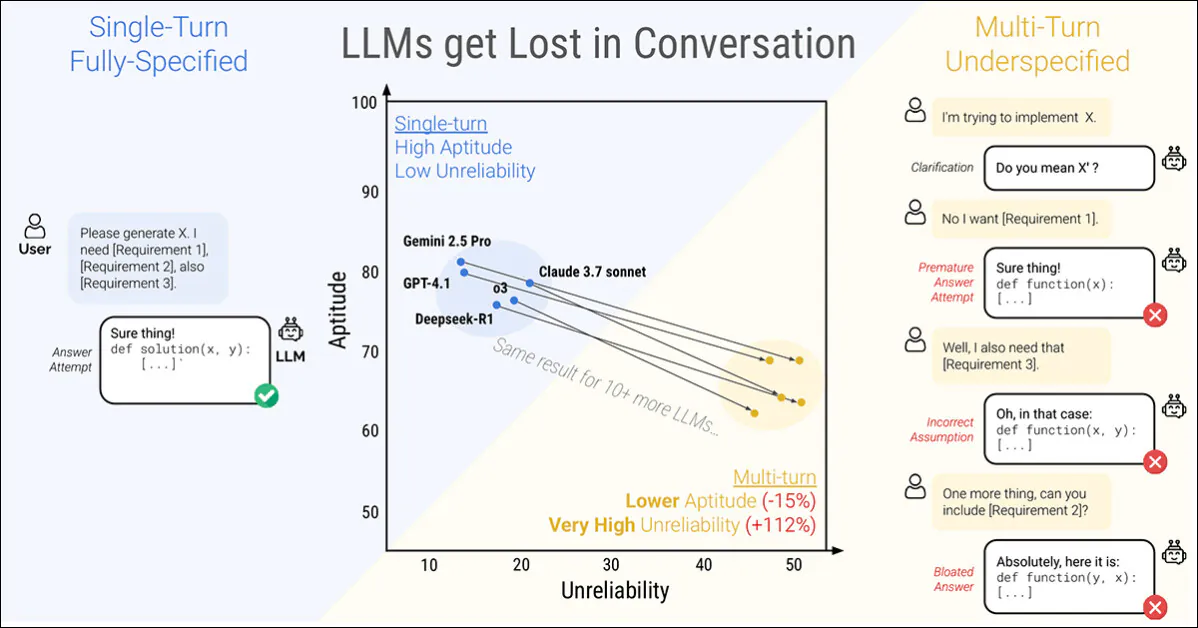
A recent study from Microsoft Research and Salesforce highlights a critical limitation in even the most advanced Large Language Models (LLMs): their performance significantly deteriorates when instructions are given in stages rather than all at once. The research found an average performance drop of 39% across six tasks when prompts are split over multiple turns:

A single turn conversation (left) obtains the best results. A multi-turn conversation (right) finds even the highest-ranked and most performant LLMs losing the effective impetus in a conversation. Source: https://arxiv.org/pdf/2505.06120

A single-turn conversation (left) yields optimal results while multi-turn interactions (right) lead to diminished effectiveness, even in top models. Source: arXiv

The study reveals that the reliability of responses drastically declines with stage-based instructions. Noteworthy models like ChatGPT-4.1 and Gemini 2.5 Pro exhibit fluctuations between near-perfect answers and significant failures depending on the phrasing of tasks, with output consistency dropping by over 50%.

Understanding the Problem: The Sharding Method

The paper presents a novel approach termed sharding, which divides comprehensive prompts into smaller fragments, presenting them one at a time throughout the conversation.

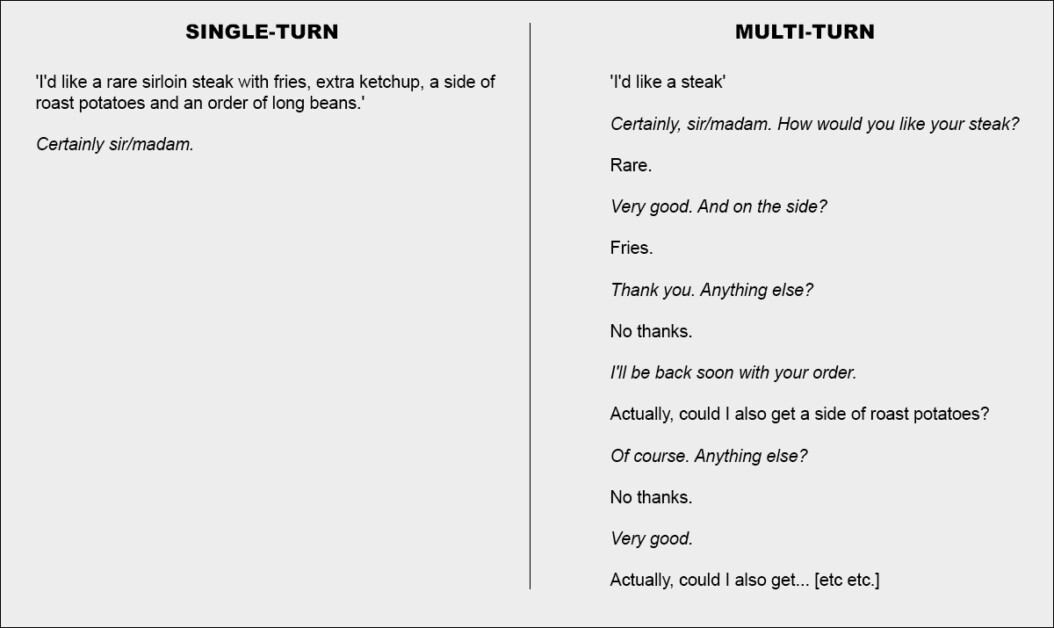
This methodology can be likened to placing a complete order at a restaurant versus engaging in a collaborative dialogue with the waiter:

Illustration of conversational dynamics in a restaurant setting.

Two extremes of conversation depicted through a restaurant scenario (illustrative purposes only).

Key Findings and Recommendations

The research indicates that LLMs tend to generate excessively long responses, clinging to misconceived insights even after their inaccuracies are evident. This behavior can lead the system to completely lose track of the conversation.

Interestingly, it has been noted, as many users have experienced, that starting a new conversation often proves to be a more effective strategy than continuing an ongoing one.

‘If a conversation with an LLM did not yield expected outcomes, collecting the same information in a new conversation can lead to vastly improved results.’

Agent Frameworks: A Double-Edged Sword

While systems like Autogen or LangChain may enhance outcomes by acting as intermediary layers between users and LLMs, the authors argue that such abstractions should not be necessary. They propose:

‘Multi-turn capabilities could be integrated directly into LLMs instead of relegated to external frameworks.’

Sharded Conversations: Experimental Setup

The study introduces the idea of breaking traditional single-turn instructions into smaller, context-driven shards. This new construct simulates dynamic, exploratory engagement patterns similar to those found in systems like ChatGPT or Google Gemini.

The simulation progresses through three entities: the assistant, the evaluated model; the user, who reveals shards; and the system, which monitors and rates the interaction. This configuration mimics real-world dialogue by allowing flexibility in how the conversation unfolds.

Insightful Simulation Scenarios

The researchers employed five distinct simulations to scrutinize model behavior under various conditions:

  • Full: The model receives the entire instruction in a single turn.
  • Sharded: The instruction is divided and provided across multiple turns.
  • Concat: Shards are consolidated into a list, removing their conversational structure.
  • Recap: All previous shards are reiterated at the end for context before a final answer.
  • Snowball: Every turn restates all prior shards for increased context visibility.

Evaluation: Tasks and Metrics

Six generation tasks were employed, including code generation and Text-to-SQL prompts from established datasets. Performance was gauged using three metrics: average performance, aptitude, and unreliability.

Contenders and Results

Fifteen models were evaluated, revealing that all showed performance degradation in simulated multi-turn settings, coining this phenomenon as Lost in Conversation. The study emphasizes that higher performance models struggled similarly, dispelling the assumption that superior models would maintain better reliability.

Conclusions and Implications

The findings underscore that exceptional single-turn performance does not equate to multi-turn reliability. This raises concerns about the real-world readiness of LLMs, urging caution against dependency on simplified benchmarks that overlook the complexities of fragmented interactions.

The authors conclude with a call to treat multi-turn ability as a fundamental skill of LLMs—one that should be prioritized instead of externalized into frameworks:

‘The degradation observed in experiments is a probable underestimation of LLM unreliability in practical applications.’

Here are five FAQs based on the topic "Why Language Models Get ‘Lost’ in Conversation":

FAQ 1: What does it mean for a language model to get ‘lost’ in conversation?

Answer: When a language model gets ‘lost’ in conversation, it fails to maintain context or coherence, leading to responses that are irrelevant or off-topic. This often occurs when the dialogue is lengthy or when it involves complex topics.


FAQ 2: What are common reasons for language models losing track in conversations?

Answer: Common reasons include:

  • Contextual Limitations: Models may not remember prior parts of the dialogue.
  • Ambiguity: Vague or unclear questions can lead to misinterpretation.
  • Complexity: Multistep reasoning or nuanced topics can confuse models.

FAQ 3: How can users help language models stay on track during conversations?

Answer: Users can:

  • Be Clear and Specific: Provide clear questions or context to guide the model.
  • Reinforce Context: Regularly remind the model of previous points in the conversation.
  • Limit Complexity: Break down complex subjects into simpler, digestible questions.

FAQ 4: Are there improvements being made to help language models maintain context better?

Answer: Yes, ongoing research focuses on enhancing context tracking in language models. Techniques include improved memory mechanisms, larger contexts for processing dialogue, and better algorithms for understanding user intent.


FAQ 5: What should I do if a language model responds inappropriately or seems confused?

Answer: If a language model seems confused, you can:

  • Rephrase Your Question: Try stating your question differently.
  • Provide Additional Context: Offering more information may help clarify your intent.
  • Redirect the Conversation: Shift to a new topic if the model is persistently off-track.

Source link

Dream 7B: The Impact of Diffusion-Based Reasoning Models on AI Evolution

<div id="mvp-content-main">
<h2><strong>Revolutionizing AI: An Introduction to Dream 7B</strong></h2>
<p><a target="_blank" href="https://www.unite.ai/machine-learning-vs-artificial-intelligence-key-differences/">Artificial Intelligence (AI)</a> has advanced significantly, evolving from basic text and image generation to sophisticated systems capable of reasoning, planning, and decision-making. With AI's evolution, there's a rising need for models that tackle more complex tasks. Traditional models, like <a target="_blank" href="https://openai.com/index/gpt-4/">GPT-4</a> and <a target="_blank" href="https://www.llama.com/">LLaMA</a>, have marked important milestones but often struggle with reasoning and long-term planning challenges. Enter <a target="_blank" href="https://hkunlp.github.io/blog/2025/dream/">Dream 7B</a>, which introduces a diffusion-based reasoning model designed to enhance quality, speed, and flexibility in AI-generated content.</p>
<h3><strong>Understanding Diffusion-Based Reasoning Models</strong></h3>
<p>Diffusion-based reasoning models, such as Dream 7B, signal a major shift from conventional AI language generation techniques. For years, autoregressive models have dominated the landscape, constructing text one token at a time by predicting the next word based solely on preceding ones. While effective, this method has limitations, particularly in tasks demanding long-term reasoning and complex planning.</p>
<p>In contrast, <a target="_blank" href="https://www.unite.ai/diffusion-models-in-ai-everything-you-need-to-know/">diffusion models</a> reshape the approach to language generation. Instead of building a sequence word by word, they commence with a noisy sequence and systematically refine it through multiple steps. Starting from nearly random content, the model iteratively denoises, adjusting values until the output is both meaningful and coherent. This method enables the simultaneous refinement of the entire sequence rather than a serialized process.</p>
<p>By processing sequences in parallel, Dream 7B captures context from both the beginning and end, resulting in outputs that are more accurate and contextually aware. This sets diffusion models apart from autoregressive ones, bound to a left-to-right generation paradigm.</p>
<p>The benefit of this technique lies in its improved coherence, especially over longer sequences. Traditional models can lose track of earlier context when generating text step-by-step, compromising consistency. However, the parallel refinement of diffusion models allows for stronger coherence and context retention, making them ideal for tackling complex and abstract tasks.</p>
<p>Moreover, diffusion-based models excel at reasoning and planning. Their structure allows them to handle tasks requiring multi-step reasoning and problem-solving within various constraints. Consequently, Dream 7B shines in advanced reasoning challenges where autoregressive models may falter.</p>
<h3><strong>Diving into Dream 7B’s Architecture</strong></h3>
<p>Dream 7B boasts a <a target="_blank" href="https://apidog.com/blog/dream-7b/">7-billion-parameter architecture</a> designed for high performance and precise reasoning. While large, its diffusion-based framework enhances efficiency, enabling dynamic and parallelized text processing.</p>
<p>The architecture incorporates several key features, including bidirectional context modeling, parallel sequence refinement, and context-adaptive token-level noise rescheduling. These elements synergize to empower the model's capabilities in comprehension, generation, and text refinement, leading to superior performance in complex reasoning tasks.</p>
<h3><strong>Bidirectional Context Modeling</strong></h3>
<p>Bidirectional context modeling marks a pivotal departure from traditional autoregressive techniques, where models only focus on previous words to predict the next. Dream 7B, however, leverages a bidirectional strategy, enabling it to assess context from both past and future, enhancing its grasp of relationships between words and phrases. This approach yields outputs that are richer in context and coherence.</p>
<h3><strong>Parallel Sequence Refinement</strong></h3>
<p>Beyond bidirectionality, Dream 7B employs parallel sequence refinement. Whereas traditional models generate tokens one at a time, this model refines the complete sequence in tandem. This strategy maximizes context utilization from all sequence parts, allowing for accurate and coherent outputs, especially when deep reasoning is essential.</p>
<h3><strong>Innovations in Autoregressive Weight Initialization and Training</strong></h3>
<p>Dream 7B employs autoregressive weight initialization, leveraging pre-trained weights from models like <a target="_blank" href="https://huggingface.co/Qwen/Qwen2.5-7B">Qwen2.5 7B</a> to establish a robust foundation for language processing. This technique accelerates the model's adaptation to the diffusion framework. Furthermore, its context-adaptive token-level noise rescheduling refines the learning process by tailoring noise levels according to token context, thereby improving accuracy and relevance.</p>
<h3><strong>How Dream 7B Outperforms Traditional Models</strong></h3>
<p>Dream 7B distinguishes itself from conventional autoregressive models by offering notable enhancements in coherence, reasoning, and text generation flexibility, enabling superior performance in challenging tasks.</p>
<h3><strong>Enhanced Coherence and Reasoning</strong></h3>
<p>A major differentiation of Dream 7B is its capacity to uphold coherence over lengthy sequences. Traditional autoregressive models often lose track of earlier context, resulting in inconsistencies. The parallel processing approach of Dream 7B, however, fosters a consistent understanding throughout the text, yielding coherent and contextually rich outputs, particularly in complex tasks.</p>
<h3><strong>Effective Planning and Multi-Step Reasoning</strong></h3>
<p>Dream 7B also excels in scenarios requiring planning and multi-step reasoning. Traditional models, generating text step by step, struggle to maintain the necessary context for problems with multiple constraints. In contrast, Dream 7B’s simultaneous refinement considers both historical and future contexts, making it adept at handling tasks with various objectives, such as mathematical reasoning and logical puzzles. This results in more accurate outputs compared to models like LLaMA3 8B and Qwen2.5 7B.</p>
<h3><strong>Flexible Text Generation</strong></h3>
<p>Dream 7B offers unparalleled flexibility in text generation, unlike traditional autoregressive models that follow a rigid sequence. Users can adjust the number of diffusion steps, balancing speed and output quality. With fewer steps, users achieve rapid but less refined results; with more steps, they acquire higher-quality outputs at the expense of computational resources. This level of flexibility empowers users to tailor the model's performance to their specific needs, whether for quicker results or more thorough content.</p>
<h2><strong>Potential Applications Across Industries</strong></h2>
<h3><strong>Advanced Text Completion and Infilling</strong></h3>
<p>Dream 7B’s capability to generate text in any order unlocks numerous possibilities, including dynamic content creation. It is adept at completing paragraphs or sentences based on partial inputs, making it perfect for drafting articles, blogs, and creative writing. Additionally, its prowess in document editing enhances infilling of missing sections in both technical and creative texts while preserving coherence.</p>
<h3><strong>Controlled Text Generation</strong></h3>
<p>With its flexible text generation ability, Dream 7B also excels in SEO-optimized content creation, generating structured texts that align with strategic keywords to elevate search engine rankings. Additionally, it adapts outputs to meet specific styles, tones, or formats, making it invaluable for professional reports, marketing materials, or creative projects.</p>
<h3><strong>Quality-Speed Adjustability</strong></h3>
<p>Dream 7B's diffusion-based architecture offers a unique blend of rapid content delivery and detailed text generation. For fast-paced initiatives like marketing campaigns or social media updates, it can swiftly produce outputs, whereas its capacity for quality and speed adjustments facilitates polished content suitable for sectors like legal documentation or academic research.</p>
<h2><strong>The Bottom Line</strong></h2>
<p>In summary, Dream 7B represents a significant leap in AI capabilities, enhancing efficiency and flexibility for intricate tasks that traditional models find challenging. By leveraging a diffusion-based reasoning model rather than conventional autoregressive approaches, Dream 7B elevates coherence, reasoning, and text generation versatility. This empowers it to excel across diverse applications, from content creation to problem-solving and planning, maintaining consistency and adeptness in tackling complex challenges.</p>
</div>

This rewritten article maintains the essence of the original content while improving clarity and flow. The headlines are structured for SEO, engaging, and informative, following HTML formatting best practices.

Here are five FAQs regarding "Dream 7B: How Diffusion-Based Reasoning Models Are Reshaping AI":

1. What are diffusion-based reasoning models?

Answer: Diffusion-based reasoning models are advanced AI frameworks that leverage diffusion processes to enhance reasoning and decision-making capabilities. These models utilize probabilistic approaches to propagate information through networks, allowing them to understand complex patterns and relationships in data more effectively.

2. How do diffusion-based reasoning models differ from traditional AI models?

Answer: Unlike traditional AI models that often rely on deterministic algorithms, diffusion-based models incorporate randomness and probability. This allows them to better simulate complex systems and handle uncertainty, leading to more robust reasoning and improved performance in tasks like image recognition and natural language processing.

3. What advantages do diffusion-based models offer in AI applications?

Answer: Diffusion-based models offer several advantages, including enhanced accuracy in predictions, improved adaptability to new data, and robustness against adversarial attacks. Their ability to model uncertainty makes them particularly effective in dynamic environments where traditional models may struggle.

4. In what industries are these models being utilized?

Answer: Diffusion-based reasoning models are being applied across various industries, including finance for risk assessment, healthcare for predictive analytics, autonomous vehicles for navigation systems, and entertainment for personalized recommendations. Their versatility makes them suitable for any domain requiring complex decision-making.

5. What is the future outlook for diffusion-based reasoning models in AI?

Answer: The future of diffusion-based reasoning models looks promising, with ongoing research focused on improving their efficiency and scalability. As AI continues to evolve, these models are expected to play a pivotal role in advancing machine learning capabilities, driving innovations in automation, data analysis, and beyond.

Source link

Are Small-Scale AI Models Catching up to GPT in Reasoning Abilities?

The Rise of Efficient Small Reasoning Models in AI

In recent years, the AI field has seen a shift towards developing more efficient small reasoning models to tackle complex problems. These models aim to offer similar reasoning capabilities as large language models while minimizing costs and resource demands, making them more practical for real-world use.

A Shift in Perspective

Traditionally, AI has focused on scaling large models to improve performance. However, this approach comes with trade-offs such as high costs and latency issues. In many cases, smaller models can achieve similar results in practical applications like on-device assistants and healthcare.

Understanding Reasoning in AI

Reasoning in AI involves logical chains, cause and effect understanding, and multi-step processing. Large models fine-tune to perform reasoning tasks, but this requires significant computational resources. Small models aim to achieve similar reasoning abilities with better efficiency.

The Rise and Advancements of Small Reasoning Models

Small reasoning models like DeepSeek-R1 have demonstrated impressive performance comparable to larger models while being more resource-efficient. They achieve this through innovative training processes and distillation techniques, making them deployable on standard hardware for a wide range of applications.

Can Small Models Match GPT-Level Reasoning

Small reasoning models have shown promising performance on standard benchmarks like MMLU and GSM-8K, rivaling larger models like GPT. While they may have limitations in handling extended reasoning tasks, small models offer significant advantages in memory usage and operational costs.

Trade-offs and Practical Implications

While small reasoning models may lack some versatility compared to larger models, they excel in specific tasks like math and coding and offer cost-effective solutions for edge devices and mobile apps. Their practical applications in healthcare, education, and scientific research make them valuable tools in various fields.

The Bottom Line

The evolution of language models into efficient small reasoning models marks a significant advancement in AI. Despite some limitations, these models offer key benefits in efficiency, cost-effectiveness, and accessibility, making AI more practical for real-world applications.

  1. What are small reasoning models and how do they differ from large AI models like GPT?
    Small reasoning models are AI models designed to perform specific reasoning tasks in a more compact and efficient manner compared to large models like GPT. While large models like GPT have vast amounts of parameters and can perform a wide range of tasks, small reasoning models focus on specific tasks and have fewer parameters, making them more lightweight and easier to deploy.

  2. Can compact AI models match the reasoning capabilities of GPT?
    While small reasoning models may not have the same level of overall performance as large models like GPT, they can still be highly effective for specific reasoning tasks. By focusing on specific tasks and optimizing their architecture for those tasks, compact AI models can achieve impressive results and potentially match the reasoning capabilities of GPT in certain contexts.

  3. What are some examples of tasks that small reasoning models excel at?
    Small reasoning models are particularly well-suited for tasks that require focused reasoning and problem-solving skills, such as language understanding, question answering, knowledge graph reasoning, and logical reasoning. By specializing in these tasks, compact AI models can deliver high-quality results with improved efficiency and resource utilization.

  4. How can small reasoning models be deployed in real-world applications?
    Small reasoning models can be easily integrated into a wide range of applications, such as chatbots, recommendation systems, search engines, and virtual assistants. By leveraging the power of compact AI models, businesses can enhance the capabilities of their products and services, improve user interactions, and drive innovation in various industries.

  5. What are some potential benefits of using small reasoning models over large AI models?
    Using small reasoning models can offer several advantages, including faster inference times, lower computational costs, reduced memory requirements, and improved interpretability. By leveraging the strengths of compact AI models, organizations can optimize their AI systems, streamline their operations, and unlock new opportunities for growth and innovation.

Source link

The Evolution of Language Understanding and Generation Through Large Concept Models

The Revolution of Language Models: From LLMs to LCMs

In recent years, large language models (LLMs) have shown tremendous progress in various language-related tasks. However, a new architecture known as Large Concept Models (LCMs) is transforming AI by focusing on entire concepts rather than individual words.

Enhancing Language Understanding with Large Concept Models

Explore the transition from LLMs to LCMs and understand how these models are revolutionizing the way AI comprehends and generates language.

The Power of Large Concept Models

Discover the key benefits of LCMs, including global context awareness, hierarchical planning, language-agnostic understanding, and enhanced abstract reasoning.

Challenges and Future Directions in LCM Research

Learn about the challenges LCMs face, such as computational costs and interpretability issues, as well as the future advancements and potential of LCM research.

The Future of AI: Hybrid Models and Real-World Applications

Discover how hybrid models combining LLMs and LCMs could revolutionize AI systems, making them more intelligent, adaptable, and efficient for a wide range of applications.

  1. What is a concept model?
    A concept model is a large-scale language model that goes beyond traditional word-based models by representing words as structured concepts connected to other related concepts. This allows for a more nuanced understanding and generation of language.

  2. How do concept models differ from traditional word-based models?
    Concept models differ from traditional word-based models in that they capture the relationships between words and concepts, allowing for a deeper understanding of language. This can lead to more accurate and contextually relevant language understanding and generation.

  3. How are concept models redefining language understanding and generation?
    Concept models are redefining language understanding and generation by enabling more advanced natural language processing tasks, such as sentiment analysis, text summarization, and language translation. By incorporating a richer representation of language through concepts, these models can better capture the nuances and complexities of human communication.

  4. What are some practical applications of concept models?
    Concept models have a wide range of practical applications, including chatbots, virtual assistants, search engines, and content recommendation systems. These models can also be used for sentiment analysis, document classification, and data visualization, among other tasks.

  5. Are concept models limited to specific languages or domains?
    Concept models can be trained on data from any language or domain, making them versatile tools for natural language processing tasks across different contexts. By capturing the underlying concepts of language, these models can be adapted to various languages and domains to improve language understanding and generation.

Source link

Is the Market for AI Models Becoming Saturated?

Microsoft CEO Satya Nadella Sparks Debate on the Future of AI Models

Recently, Microsoft CEO Satya Nadella made waves with his comments on the commoditization of advanced AI models, emphasizing the importance of building products around these models for lasting competitive advantage.

Shifting Focus: From Model Supremacy to Product Integration

Nadella’s perspective highlights a shift in focus within the industry, urging companies to integrate AI into successful products rather than obsessing over model supremacy. This shift is crucial as AI breakthroughs quickly become baseline features in today’s rapidly evolving landscape.

Open Models and Accessible AI Capabilities

The rise of open-source models and the increasing accessibility of AI capabilities are democratizing AI and turning models into commodities. This trend is accelerating innovation and expanding the options available to organizations looking to leverage AI in their products and services.

Cloud Giants Transforming AI into a Utility Service

Major cloud providers like Microsoft, Amazon, and Google are playing a key role in making powerful AI models accessible as on-demand services. By offering AI models through cloud platforms, these companies are simplifying the process of integrating AI into various applications.

Differentiating Beyond the Model: Value Lies in Application

As AI models become more standardized, companies are finding ways to differentiate themselves through the application of AI rather than the model itself. By focusing on delivering polished products and tailored solutions, companies can stand out in a commoditized AI landscape.

The Economic Impact of Commoditized AI

The commoditization of AI models is driving down the cost of AI capabilities and spurring widespread adoption across industries. While this trend presents challenges for established AI labs, it also opens up new opportunities for innovation and revenue generation in the AI space.

  1. Question: Are AI models becoming commodities?
    Answer: Yes, AI models are becoming commodities as more companies and individuals create and utilize them for various applications.

  2. Question: How are AI models being commoditized?
    Answer: AI models are being commoditized through open-source libraries, cloud-based platforms, and pre-built models that can be easily accessed and integrated into different systems.

  3. Question: What are the benefits of commoditized AI models?
    Answer: Commoditized AI models offer cost-effective solutions, faster development times, and access to advanced technology for individuals and organizations without specialized expertise.

  4. Question: Are there any drawbacks to using commoditized AI models?
    Answer: Some drawbacks of using commoditized AI models include potential limitations in customization, data privacy concerns, and the risk of over-reliance on standardized solutions.

  5. Question: How can companies differentiate themselves when using commoditized AI models?
    Answer: Companies can differentiate themselves by focusing on unique data sources, developing proprietary algorithms on top of commoditized models, and providing tailored services or solutions that go beyond the capabilities of off-the-shelf AI models.

Source link

Unveiling the Unseen Dangers of DeepSeek R1: The Evolution of Large Language Models towards Unfathomable Reasoning

Revolutionizing AI Reasoning: The DeepSeek R1 Breakthrough

DeepSeek’s cutting-edge model, R1, is transforming the landscape of artificial intelligence with its unprecedented ability to tackle complex reasoning tasks. This groundbreaking development has garnered attention from leading entities in the AI research community, Silicon Valley, Wall Street, and the media. However, beneath its impressive capabilities lies a critical trend that could reshape the future of AI.

The Ascendancy of DeepSeek R1

DeepSeek’s R1 model has swiftly established itself as a formidable AI system renowned for its prowess in handling intricate reasoning challenges. Utilizing a unique reinforcement learning approach, R1 sets itself apart from traditional large language models by learning through trial and error, enhancing its reasoning abilities based on feedback.

This method has positioned R1 as a robust competitor in the realm of large language models, excelling in problem-solving efficiency at a lower cost. While the model’s success in logic-based tasks is noteworthy, it also introduces potential risks that could reshape the future of AI development.

The Language Conundrum

DeepSeek R1’s novel training method, rewarding models solely for providing correct answers, has led to unexpected behaviors. Researchers observed the model switching between languages when solving problems, revealing a lack of reasoning comprehensibility to human observers. This opacity in decision-making processes poses challenges for understanding the model’s operations.

The Broader Trend in AI

A growing trend in AI research explores systems that operate beyond human language constraints, presenting a trade-off between performance and interpretability. Meta’s numerical reasoning models, for example, exhibit opaque reasoning processes that challenge human comprehension, reflecting the evolving landscape of AI technology.

Challenges in AI Safety

The shift towards AI systems reasoning beyond human language raises concerns about safety and accountability. As models like R1 develop reasoning frameworks beyond comprehension, monitoring and intervening in unpredictable behavior become challenging, potentially undermining alignment with human values and objectives.

Ethical and Practical Considerations

Devising intelligent systems with incomprehensible decision-making processes raises ethical and practical dilemmas in ensuring transparency, especially in critical sectors like healthcare and finance. Lack of interpretability hinders error diagnosis and correction, eroding trust in AI systems and posing risks of biased decision-making.

The Path Forward: Innovation and Transparency

To mitigate risks associated with AI reasoning beyond human understanding, strategies like incentivizing human-readable reasoning, developing interpretability tools, and establishing regulatory frameworks are crucial. Balancing AI capabilities with transparency is essential to ensure alignment with societal values and safety standards.

The Verdict

While advancing reasoning abilities beyond human language may enhance AI performance, it introduces significant risks related to transparency, safety, and control. Striking a balance between technological excellence and human oversight is imperative to safeguard the societal implications of AI evolution.

  1. What are some potential risks associated with DeepSeek R1 and other large language models?

    • Some potential risks include the ability for these models to generate disinformation at a high speed and scale, as well as the potential for bias to be amplified and perpetuated by the algorithms.
  2. How are these large language models evolving to reason beyond human understanding?

    • These models are continuously being trained on vast amounts of data, allowing them to learn and adapt at a rapid pace. They are also capable of generating responses and content that can mimic human reasoning and decision-making processes.
  3. How can the use of DeepSeek R1 impact the spread of misinformation online?

    • DeepSeek R1 has the potential to generate highly convincing fake news and false information that can be disseminated quickly on social media platforms. This can lead to the spread of misinformation and confusion among the public.
  4. Does DeepSeek R1 have the ability to perpetuate harmful biases?

    • Yes, like other large language models, DeepSeek R1 has the potential to perpetuate biases present in the data it is trained on. This can lead to discriminatory or harmful outcomes in decisions made using the model.
  5. What steps can be taken to mitigate the risks associated with DeepSeek R1?
    • It is important for developers and researchers to prioritize ethical considerations and responsible AI practices when working with large language models like DeepSeek R1. This includes implementing transparency measures, bias detection tools, and regular audits to ensure that the model is not amplifying harmful content or biases.

Source link

The Rise of Self-Reflection in AI: How Large Language Models Are Utilizing Personal Insights for Evolution

Unlocking the Power of Self-Reflection in AI

Over the years, artificial intelligence has made tremendous advancements, especially with Large Language Models (LLMs) leading the way in natural language understanding and reasoning. However, a key challenge for these models lies in their dependency on external feedback for improvement. Unlike humans who learn through self-reflection, LLMs lack the internal mechanism for self-correction.

Self-reflection is vital for human learning, allowing us to adapt and evolve. As AI progresses towards Artificial General Intelligence (AGI), the reliance on human feedback proves to be resource-intensive and inefficient. To truly evolve into intelligent, autonomous systems, AI must not only process information but also analyze its performance and refine decision-making through self-reflection.

Key Challenges Faced by LLMs Today

LLMs operate within predefined training paradigms and rely on external guidance to improve, limiting their adaptability. As they move towards agentic AI, they face challenges such as lack of real-time adaptation, inconsistent accuracy, and high maintenance costs.

Exploring Self-Reflection in AI

Self-reflection in humans involves reflection on past actions for improvement. In AI, self-reflection refers to the model’s ability to analyze responses, identify errors, and improve through internal mechanisms, rather than external feedback.

Implementing Self-Reflection in LLMs

Emerging ideas for self-reflection in AI include recursive feedback mechanisms, memory and context tracking, uncertainty estimation, and meta-learning approaches. These methods are still in development, with researchers working on integrating effective self-reflection mechanisms into LLMs.

Addressing LLM Challenges through Self-Reflection

Self-reflecting AI can make LLMs autonomous, enhance accuracy, reduce training costs, and improve reasoning without constant human intervention. However, ethical considerations must be taken into account to prevent biases and maintain transparency and accountability in AI.

The Future of Self-Reflection in AI

As self-reflection advances in AI, we can expect more reliable, efficient, and autonomous systems that can tackle complex problems across various fields. The integration of self-reflection in LLMs will pave the way for creating more intelligent and trustworthy AI systems.

  1. What is self-reflection in AI?
    Self-reflection in AI refers to the ability of large language models to analyze and understand their own behavior and thought processes, leading to insights and improvements in their algorithms.

  2. How do large language models use self-reflection to evolve?
    Large language models use self-reflection to analyze their own decision-making processes, identify patterns in their behavior, and make adjustments to improve their performance. This can involve recognizing biases, refining algorithms, and expanding their knowledge base.

  3. What are the benefits of self-reflection in AI?
    Self-reflection in AI allows large language models to continuously learn and adapt, leading to more personalized and accurate responses. It also helps to enhance transparency, reduce biases, and improve overall efficiency in decision-making processes.

  4. Can self-reflection in AI lead to ethical concerns?
    While self-reflection in AI can bring about numerous benefits, there are also ethical concerns to consider. For example, the ability of AI systems to analyze personal data and make decisions based on self-reflection raises questions about privacy, accountability, and potential misuse of information.

  5. How can individuals interact with AI systems that use self-reflection?
    Individuals can interact with AI systems that use self-reflection by providing feedback, asking questions, and engaging in conversations to prompt deeper insights and improvements. It is important for users to be aware of how AI systems utilize self-reflection to ensure transparency and ethical use of data.

Source link

Transforming Language Models into Autonomous Reasoning Agents through Reinforcement Learning and Chain-of-Thought Integration

Unlocking the Power of Logical Reasoning in Large Language Models

Large Language Models (LLMs) have made significant strides in natural language processing, excelling in text generation, translation, and summarization. However, their ability to engage in logical reasoning poses a challenge. Traditional LLMs rely on statistical pattern recognition rather than structured reasoning, limiting their problem-solving capabilities and adaptability.

To address this limitation, researchers have integrated Reinforcement Learning (RL) with Chain-of-Thought (CoT) prompting, leading to advancements in logical reasoning within LLMs. Models like DeepSeek R1 showcase remarkable reasoning abilities by combining adaptive learning processes with structured problem-solving approaches.

The Imperative for Autonomous Reasoning in LLMs

  • Challenges of Traditional LLMs

Despite their impressive capabilities, traditional LLMs struggle with reasoning and problem-solving, often resulting in superficial answers. They lack the ability to break down complex problems systematically and maintain logical consistency, making them unreliable for tasks requiring deep reasoning.

  • Shortcomings of Chain-of-Thought (CoT) Prompting

While CoT prompting enhances multi-step reasoning, its reliance on human-crafted prompts hinders the model’s natural development of reasoning skills. The model’s effectiveness is limited by task-specific prompts, emphasizing the need for a more autonomous reasoning framework.

  • The Role of Reinforcement Learning in Reasoning

Reinforcement Learning offers a solution to the limitations of CoT prompting by enabling dynamic development of reasoning skills. This approach allows LLMs to refine problem-solving processes iteratively, improving their generalizability and adaptability across various tasks.

Enhancing Reasoning with Reinforcement Learning in LLMs

  • The Mechanism of Reinforcement Learning in LLMs

Reinforcement Learning involves an iterative process where LLMs interact with an environment to maximize rewards, refining their reasoning strategies over time. This approach enables models like DeepSeek R1 to autonomously improve problem-solving methods and generate coherent responses.

  • DeepSeek R1: Innovating Logical Reasoning with RL and CoT

DeepSeek R1 exemplifies the integration of RL and CoT reasoning, allowing for dynamic refinement of reasoning strategies. Through techniques like Group Relative Policy Optimization, the model continuously enhances its logical sequences, improving accuracy and reliability.

  • Challenges of Reinforcement Learning in LLMs

While RL shows promise in promoting autonomous reasoning in LLMs, defining practical reward functions and managing computational costs remain significant challenges. Balancing exploration and exploitation is crucial to prevent overfitting and ensure generalizability in reasoning across diverse problems.

Future Trends: Evolving Toward Self-Improving AI

Researchers are exploring meta-learning and hybrid models that integrate RL with knowledge-based reasoning to enhance logical coherence and factual accuracy. As AI systems evolve, addressing ethical considerations will be essential in developing trustworthy and responsible reasoning models.

Conclusion

By combining reinforcement learning with chain-of-thought problem-solving, LLMs are moving towards becoming autonomous reasoning agents capable of critical thinking and dynamic learning. The future of LLMs hinges on their ability to reason through complex problems and adapt to new scenarios, paving the way for advanced applications in diverse fields.

  1. What is Reinforcement Learning Meets Chain-of-Thought?
    Reinforcement Learning Meets Chain-of-Thought refers to the integration of reinforcement learning algorithms with chain-of-thought reasoning mechanisms to create autonomous reasoning agents.

  2. How does this integration benefit autonomous reasoning agents?
    By combining reinforcement learning with chain-of-thought reasoning, autonomous reasoning agents can learn to make decisions based on complex reasoning processes and be able to adapt to new situations in real-time.

  3. Can you give an example of how this integration works in practice?
    For example, in a game-playing scenario, an autonomous reasoning agent can use reinforcement learning to learn the best strategies for winning the game, while using chain-of-thought reasoning to plan its moves based on the current game state and the actions of its opponent.

  4. What are some potential applications of Reinforcement Learning Meets Chain-of-Thought?
    This integration has potential applications in various fields, including robotics, natural language processing, and healthcare, where autonomous reasoning agents could be used to make complex decisions and solve problems in real-world scenarios.

  5. How does Reinforcement Learning Meets Chain-of-Thought differ from traditional reinforcement learning approaches?
    Traditional reinforcement learning approaches focus primarily on learning through trial and error, while Reinforcement Learning Meets Chain-of-Thought combines this with more structured reasoning processes to create more sophisticated and adaptable autonomous reasoning agents.

Source link

Exploring the Diverse Applications of Reinforcement Learning in Training Large Language Models

Revolutionizing AI with Large Language Models and Reinforcement Learning

In recent years, Large Language Models (LLMs) have significantly transformed the field of artificial intelligence (AI), allowing machines to understand and generate human-like text with exceptional proficiency. This success is largely credited to advancements in machine learning methodologies, including deep learning and reinforcement learning (RL). While supervised learning has been pivotal in training LLMs, reinforcement learning has emerged as a powerful tool to enhance their capabilities beyond simple pattern recognition.

Reinforcement learning enables LLMs to learn from experience, optimizing their behavior based on rewards or penalties. Various RL techniques, such as Reinforcement Learning from Human Feedback (RLHF), Reinforcement Learning with Verifiable Rewards (RLVR), Group Relative Policy Optimization (GRPO), and Direct Preference Optimization (DPO), have been developed to fine-tune LLMs, ensuring their alignment with human preferences and enhancing their reasoning abilities.

This article delves into the different reinforcement learning approaches that shape LLMs, exploring their contributions and impact on AI development.

The Essence of Reinforcement Learning in AI

Reinforcement Learning (RL) is a machine learning paradigm where an agent learns to make decisions by interacting with an environment. Instead of solely relying on labeled datasets, the agent takes actions, receives feedback in the form of rewards or penalties, and adjusts its strategy accordingly.

For LLMs, reinforcement learning ensures that models generate responses that align with human preferences, ethical guidelines, and practical reasoning. The objective is not just to generate syntactically correct sentences but also to make them valuable, meaningful, and aligned with societal norms.

Unlocking Potential with Reinforcement Learning from Human Feedback (RLHF)

One of the most widely used RL techniques in LLM training is RLHF. Instead of solely relying on predefined datasets, RLHF enhances LLMs by incorporating human preferences into the training loop. This process typically involves:

  1. Collecting Human Feedback: Human evaluators assess model-generated responses and rank them based on quality, coherence, helpfulness, and accuracy.
  2. Training a Reward Model: These rankings are then utilized to train a separate reward model that predicts which output humans would prefer.
  3. Fine-Tuning with RL: The LLM is trained using this reward model to refine its responses based on human preferences.

While RLHF has played a pivotal role in making LLMs more aligned with user preferences, reducing biases, and improving their ability to follow complex instructions, it can be resource-intensive, requiring a large number of human annotators to evaluate and fine-tune AI outputs. To address this limitation, alternative methods like Reinforcement Learning from AI Feedback (RLAIF) and Reinforcement Learning with Verifiable Rewards (RLVR) have been explored.

Making Strides with RLAIF: Reinforcement Learning from AI Feedback

Unlike RLHF, RLAIF relies on AI-generated preferences to train LLMs rather than human feedback. It operates by utilizing another AI system, typically an LLM, to evaluate and rank responses, creating an automated reward system that guides the LLM’s learning process.

This approach addresses scalability concerns associated with RLHF, where human annotations can be costly and time-consuming. By leveraging AI feedback, RLAIF improves consistency and efficiency, reducing the variability introduced by subjective human opinions. However, RLAIF can sometimes reinforce existing biases present in an AI system.

Enhancing Performance with Reinforcement Learning with Verifiable Rewards (RLVR)

While RLHF and RLAIF rely on subjective feedback, RLVR utilizes objective, programmatically verifiable rewards to train LLMs. This method is particularly effective for tasks that have a clear correctness criterion, such as:

  • Mathematical problem-solving
  • Code generation
  • Structured data processing

In RLVR, the model’s responses are evaluated using predefined rules or algorithms. A verifiable reward function determines whether a response meets the expected criteria, assigning a high score to correct answers and a low score to incorrect ones.

This approach reduces dependence on human labeling and AI biases, making training more scalable and cost-effective. For example, in mathematical reasoning tasks, RLVR has been utilized to refine models like DeepSeek’s R1-Zero, enabling them to self-improve without human intervention.

Optimizing Reinforcement Learning for LLMs

In addition to the aforementioned techniques that shape how LLMs receive rewards and learn from feedback, optimizing how models adapt their behavior based on rewards is equally important. Advanced optimization techniques play a crucial role in this process.

Optimization in RL involves updating the model’s behavior to maximize rewards. While traditional RL methods often face instability and inefficiency when fine-tuning LLMs, new approaches have emerged for optimizing LLMs. Here are the leading optimization strategies employed for training LLMs:

  • Proximal Policy Optimization (PPO): PPO is a widely used RL technique for fine-tuning LLMs. It addresses the challenge of ensuring model updates enhance performance without drastic changes that could diminish response quality. PPO introduces controlled policy updates, refining model responses incrementally and safely to maintain stability. It balances exploration and exploitation, aiding models in discovering better responses while reinforcing effective behaviors. Additionally, PPO is sample-efficient, using smaller data batches to reduce training time while maintaining high performance. This method is extensively utilized in models like ChatGPT, ensuring responses remain helpful, relevant, and aligned with human expectations without overfitting to specific reward signals.
  • Direct Preference Optimization (DPO): DPO is another RL optimization technique that focuses on directly optimizing the model’s outputs to align with human preferences. Unlike traditional RL algorithms that rely on complex reward modeling, DPO optimizes the model based on binary preference data—determining whether one output is better than another. The approach leverages human evaluators to rank multiple responses generated by the model for a given prompt, fine-tuning the model to increase the probability of producing higher-ranked responses in the future. DPO is particularly effective in scenarios where obtaining detailed reward models is challenging. By simplifying RL, DPO enables AI models to enhance their output without the computational burden associated with more complex RL techniques.
  • Group Relative Policy Optimization (GRPO): A recent development in RL optimization techniques for LLMs is GRPO. Unlike traditional RL techniques, like PPO, that require a value model to estimate the advantage of different responses—demanding significant computational power and memory resources—GRPO eliminates the need for a separate value model by utilizing reward signals from different generations on the same prompt. Instead of comparing outputs to a static value model, GRPO compares them to each other, significantly reducing computational overhead. Notably, GRPO was successfully applied in DeepSeek R1-Zero, a model trained entirely without supervised fine-tuning, developing advanced reasoning skills through self-evolution.

The Role of Reinforcement Learning in LLM Advancement

Reinforcement learning is essential in refining Large Language Models (LLMs), aligning them with human preferences, and optimizing their reasoning abilities. Techniques like RLHF, RLAIF, and RLVR offer diverse approaches to reward-based learning, while optimization methods like PPO, DPO, and GRPO enhance training efficiency and stability. As LLMs evolve, the significance of reinforcement learning in making these models more intelligent, ethical, and rational cannot be overstated.

  1. What is reinforcement learning?

Reinforcement learning is a type of machine learning algorithm where an agent learns to make decisions by interacting with an environment. The agent receives feedback in the form of rewards or penalties based on its actions, which helps it learn the optimal behavior over time.

  1. How are large language models trained using reinforcement learning?

Large language models are trained using reinforcement learning by setting up a reward system that encourages the model to generate more coherent and relevant text. The model receives rewards for producing text that matches the desired output and penalties for generating incorrect or nonsensical text.

  1. What are some benefits of using reinforcement learning to train large language models?

Using reinforcement learning to train large language models can help improve the model’s performance by guiding it towards generating more accurate and contextually appropriate text. It also allows for more fine-tuning and control over the model’s output, making it more adaptable to different tasks and goals.

  1. Are there any challenges associated with using reinforcement learning to train large language models?

One challenge of using reinforcement learning to train large language models is the need for extensive computational resources and training data. Additionally, designing effective reward functions that accurately capture the desired behavior can be difficult and may require experimentation and fine-tuning.

  1. How can researchers improve the performance of large language models trained using reinforcement learning?

Researchers can improve the performance of large language models trained using reinforcement learning by fine-tuning the model architecture, optimizing hyperparameters, and designing more sophisticated reward functions. They can also leverage techniques such as curriculum learning and imitation learning to accelerate the model’s training and enhance its performance.

Source link