
What If the Founding Fathers Had Google Workspace? A Playful Look at Colonial Collaboration
In a humorous new commercial, Google envisions a world where the Founding Fathers collaborate using modern tools. Released 250 years after the Declaration of Independence, the ad asks: How would history change if they had access to Google Workspace?
A Hilarious Twist on 1776: “Group Project, But Make It 1776”
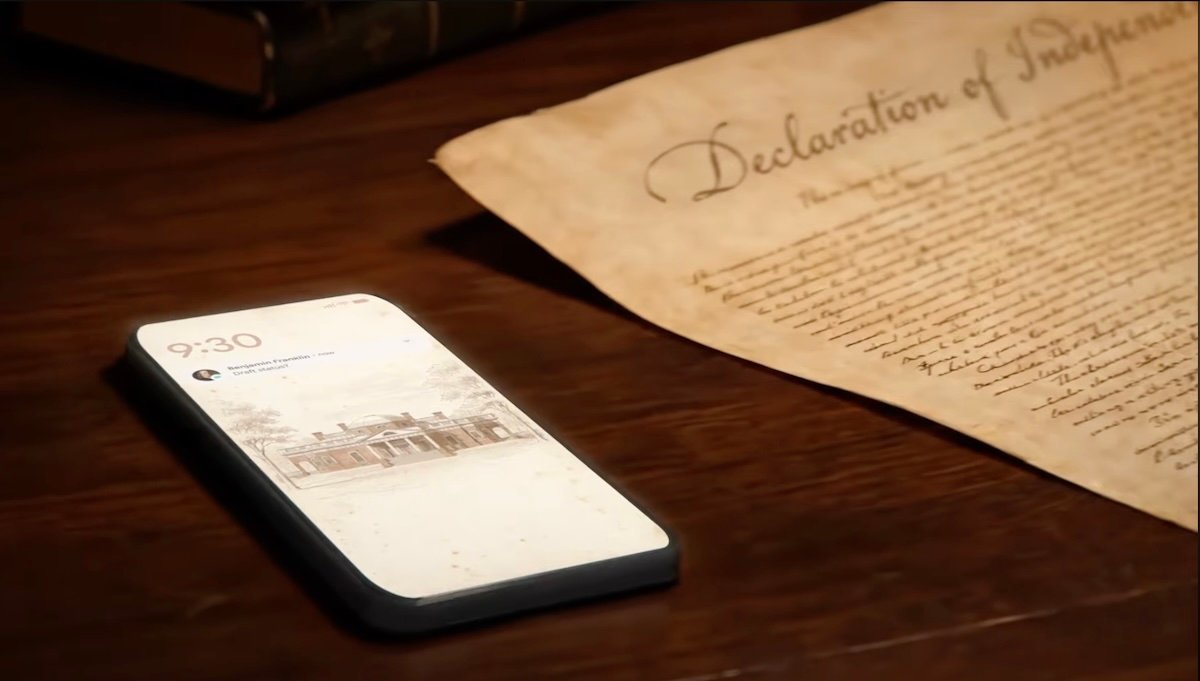
With the tagline “Group project, but make it 1776,” the advertisement humorously portrays Thomas Jefferson working on the Declaration. Amidst his drafting, he receives a playful text from Ben Franklin, triggering a Google-centric collaboration. Edits flow through Google Docs, meetings are scheduled in Google Calendar, and remote sessions are conducted via Google Meet, where attendees curiously keep their cameras off. The project reaches completion with e-signatures, immediately followed by celebratory fireworks.
AI Makes an Appearance in the Founding Process
In this futuristic take, AI plays a key role. The fictional founders employ Google’s “help me visualize” AI to explore different animals for the national seal. Meanwhile, the AI assistant, Gemini, takes notes during meetings and weighs in on a request from King George III for document access.
Tongue-in-Cheek Humor Meets Discreet AI Promotion
The ad is filled with playful banter—at one point, Sam Adams jokingly suggests, “Can we settle this over beers?” Unlike many recent commercials, the AI promotion is subtle. In contrast to a previous Google ad where AI was touted for enhancing a heartfelt fan letter, this one refrains from suggesting that the Declaration itself could be improved by technology. Interestingly, the overall video quality seems to exhibit the distinctive sheen of AI-generated content.
Viewer Reactions: Mostly Positive, but Mixed Feelings on Bluesky
While feedback on YouTube and Instagram has largely been favorable, reactions on Bluesky have been more critical. Users have labeled the ad as “cringey” and “stunningly tone deaf,” with the AI factor drawing significant scrutiny. Historian Angus Johnston pointed out the irony that much of the content offers little actual AI insight.
The Debate on AI’s Role in Political Collaboration
Johnston noted, “Even in a corny fantasy joke, it’s impossible to make the case that AI is a useful tool for political organizing, writing, or human collaboration.”
When you purchase through links in our articles, we may earn a small commission. This doesn’t affect our editorial independence.
Here are five FAQs regarding the new Google commercial that imagines a Declaration of Independence written with the help of AI:
FAQ 1: What is the main premise of the Google commercial?
Answer: The Google commercial presents an imaginative scenario where figures like Thomas Jefferson collaborate with AI to draft the Declaration of Independence. This creative concept explores the intersection of history and technology, highlighting how AI can enhance human creativity and decision-making.
FAQ 2: What message is Google trying to convey through this commercial?
Answer: The commercial aims to illustrate the potential of AI in aiding innovation and thought processes. By showing historical figures using modern technology, Google emphasizes the idea that AI can support individuals in crafting significant ideas and solutions, much like it can help today.
FAQ 3: How does the commercial portray AI’s role in the writing process?
Answer: In the commercial, AI is depicted as an assistant that contributes ideas, offers suggestions, and helps refine language. This portrayal suggests that AI can serve as a collaborative tool rather than replacing human creativity, emphasizing partnership between technology and people.
FAQ 4: What historical references are made in the commercial?
Answer: The commercial features historical figures such as Thomas Jefferson and Benjamin Franklin, referencing elements of the original Declaration of Independence. These references serve to connect the past with contemporary technological advancements, illustrating how foundational ideas can evolve with new tools.
FAQ 5: How has the audience reacted to this concept?
Answer: Audience reactions have been mixed, with many appreciating the creative take on historical events and the potential of AI. Some viewers express excitement about the possibilities of using technology for collaborative writing, while others may voice concerns about the implications of AI in creative processes. Overall, it sparks conversations about innovation and ethics in technology.
No comment yet, add your voice below!