
Digg Rises Again: A Fresh Take on News Aggregation
Digg makes its comeback yet again.
Just months after its public launch, the revamped version of Kevin Rose’s once-thriving link-sharing platform halted operations in March as the company pivoted its strategy. Originally redesigned to take on the massive community site Reddit, the new Digg struggled with an influx of bot traffic and failed to carve out a unique identity in a crowded market.
A New Direction for Digg
Following layoffs, the startup recognized the need for a fundamental change. In April, Rose, now a partner at True Ventures, committed to reimagining Digg.
Introducing the Redesigned Digg
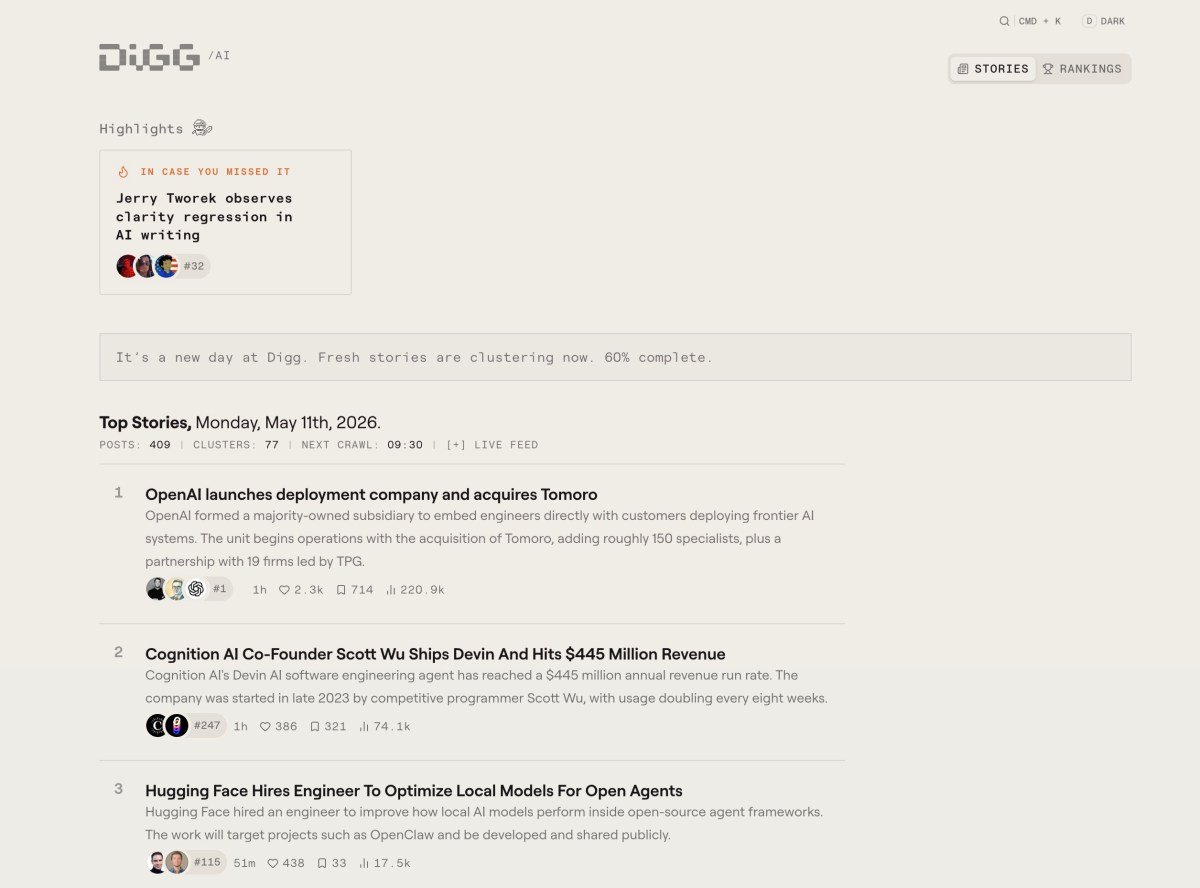
On Friday evening, Rose teased a preview of the newly revamped Digg, distancing it from its previous Reddit imitation to resemble more closely its original role as a news aggregator.
The updated platform now focuses on ranking news—initially zeroing in on AI stories.
Purpose Driven by AI News
In communication with beta testers, the company expressed its mission to “identify the most influential voices in the field” and highlight the news deserving of attention. Although currently trialing this concept within the AI arena, Digg has plans to broaden its scope to other subjects if successful.
Beta testers were advised that the platform is still in its early stages and may be “buggy,” primarily serving as an initial look rather than a formal launch.
Features and Functionality
On the current homepage, Digg highlights four primary stories: the most viewed, a story trending upward, the fastest-rising article, and an “In Case You Missed It” feature. Below this, users can see a ranked list of daily top stories, complete with engagement metrics such as views, comments, likes, and saves. Notably, these metrics are based on real-time data from X, coupled with sentiment analysis and signal detection to discern what truly matters.
As Rose noted on X, when key figures like OpenAI CEO Sam Altman engage with a topic on AI, it often triggers expansive discussions and heightened interest, a trend the new Digg aims to capitalize on.
Potential Challenges Ahead
While the emphasis on data may intrigue analytics aficionados—offering visual insights into engagement dynamics—it’s uncertain whether everyday users will find significant value beyond confirming that popular tweets can spark viral conversations.
Digg also ranks the top 1,000 individuals, companies, and politicians involved with AI, providing a comprehensive view of who’s influencing the discourse in this space.
Will Digg Compete in a Crowded Landscape?
For those pressed for time and wanting to stay updated on AI news, Digg may offer utility. Yet, it remains unclear why users would choose Digg over their preferred news app, RSS reader, or even the X “For You” feed, especially in light of the current lack of on-site discussion.
The platform could face difficulties as it branches into other topics, given that AI news is uniquely popular on X. Other subjects may lack the same traction, particularly after the shift in the social media landscape spurred by Musk’s acquisition of Twitter, leading to the emergence of competitors like Meta’s Threads.
Conclusion: A Glimpse of Hope for Publishers
However, should Digg gain traction, it could become a valuable traffic source for publishers grappling with diminishing visits due to changing search algorithms and AI-generated summaries that satisfy users’ queries before they reach a website.
When you purchase through links in our articles, we may earn a small commission. This doesn’t affect our editorial independence.
Here are five FAQs about Digg’s new venture as an AI news aggregator:
FAQ 1: What is Digg’s new AI news aggregator?
Answer: Digg’s AI news aggregator is a platform that utilizes artificial intelligence to curate and summarize news articles from various sources. It aims to provide users with relevant and personalized news content based on their interests and reading habits.
FAQ 2: How does the AI prioritize news stories?
Answer: The AI algorithm evaluates multiple factors, including trending topics, user preferences, and engagement metrics, to determine which stories are most relevant. This ensures that users receive timely and interesting news that aligns with their interests.
FAQ 3: Can I customize the news I see on Digg?
Answer: Yes! Users can personalize their news feed by selecting topics of interest, following specific sources, and providing feedback on articles. This customization allows the AI to better tailor the content to meet individual preferences.
FAQ 4: Is the information provided by Digg reliable?
Answer: Digg employs a combination of AI algorithms and human editorial oversight to assess the credibility of sources and the accuracy of information. While the AI aggregates news from a wide range of outlets, users are encouraged to verify information from trusted sources when necessary.
FAQ 5: How can I access the Digg AI news aggregator?
Answer: The Digg AI news aggregator is available through the Digg website and mobile app. Users can create an account or log in to start exploring curated news articles tailored to their interests. The platform is designed to be user-friendly and easily navigable.
Related posts:
- The Future of AI-Powered Databases: Oracle’s HeatWave GenAI
- Innovating Code Optimization: Meta’s LLM Compiler Redefines Compiler Design with AI-Powered Technology
- AI-Powered Platform by Augment Code Is Launched to Transform Team-Based Software Development
- The Future of Self-Driving Technology: Waabi’s AI-Powered Virtual Trucks
No comment yet, add your voice below!